Caring Cultures in end-of-life care
Telling about caring cultures in end-of-life care. Students and citizen scientists doing intercultural and intergenerational research
Care refers to a practice of mindfulness and stands for a fundamental belief put into practice, for caring activities and attentive affection. In a broad, political and political science understanding, “care” refers to a policy that organizations, communities or even society as a whole can and should follow. “Care cultures” are cultures of social systems, i.e., families, teams, organizations, or communities that strive to care for vulnerable people. The focus is on promoting social and organizational conditions that make good care possible.
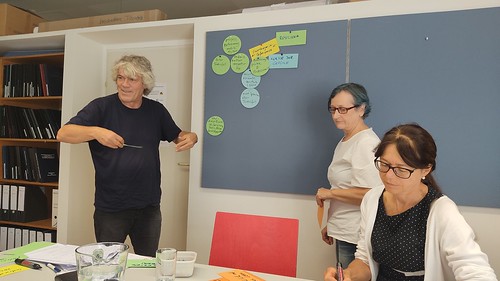
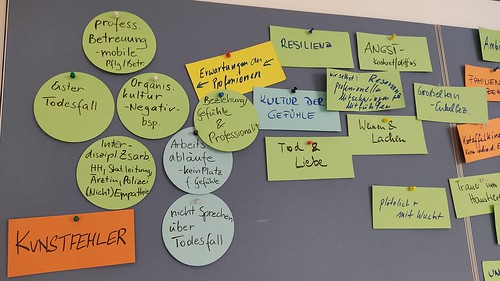
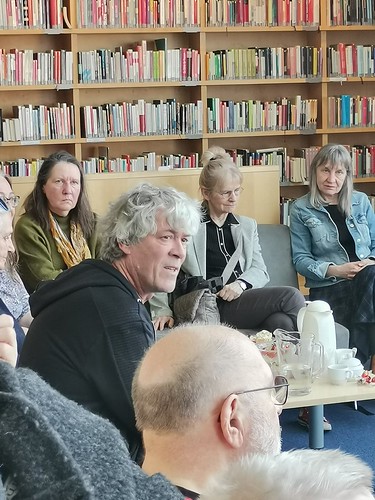
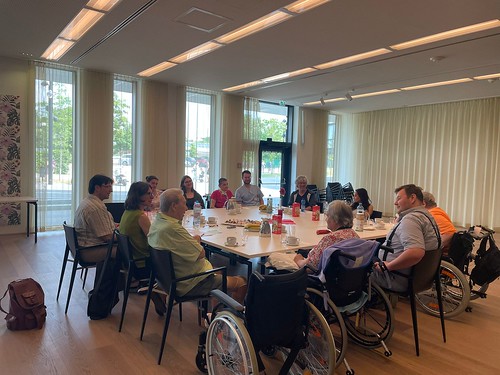
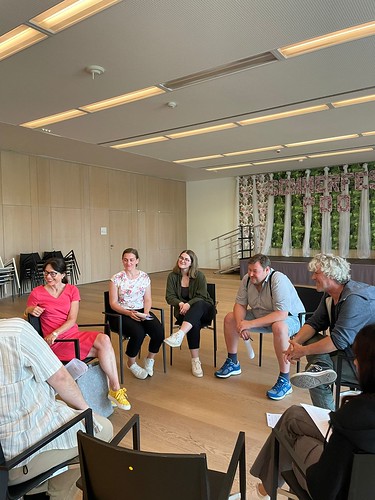
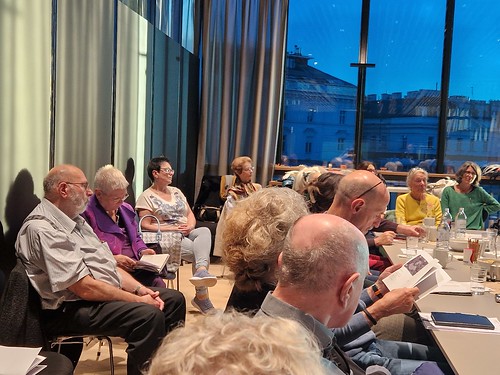
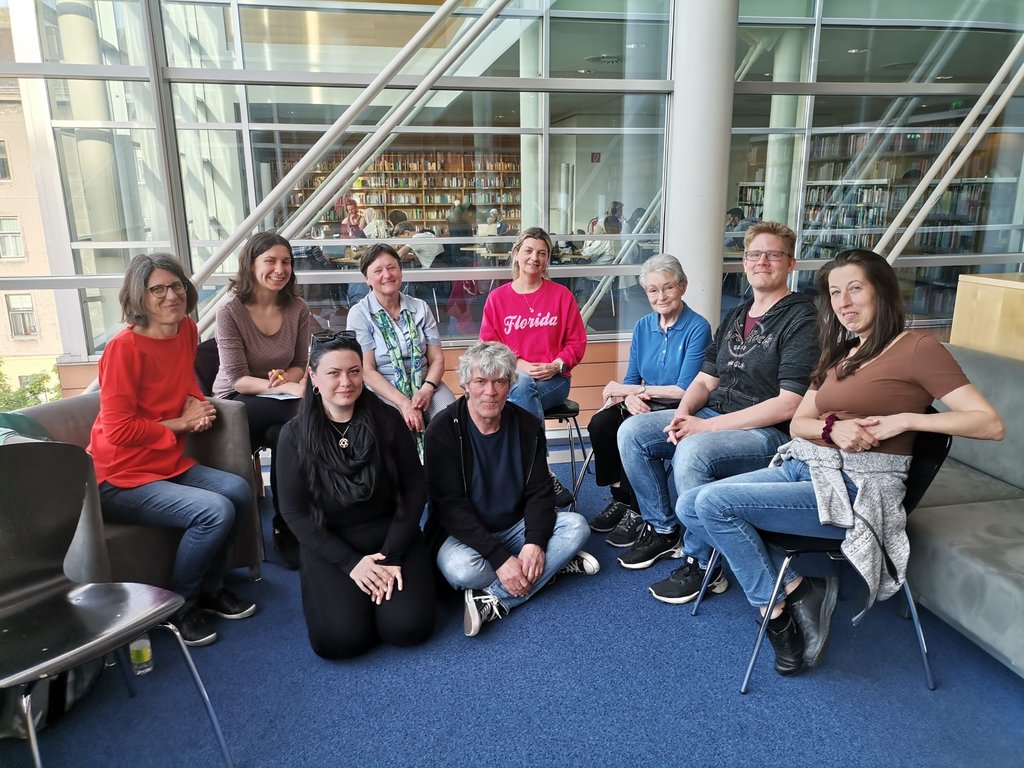
Many students in training for nursing professions encounter dying people for the first time during their first internships. They are not always well prepared for the emotional impact that dying, death and bereavement can have on them. The project has created a space where students can share and reflect on their experiences. This was achieved in 13 intergenerational and intercultural storytelling cafés, in focus groups and in qualitative interviews. The stories were told together with people with dementia and elderly people as citizen scientists.
Pupils from the partner school, specializing in social care and elderly care, and students from the Bachelor's program in Applied Nursing Science helped prepare the storytelling cafés, participated in them, and co-moderated them. The storytelling cafés were recorded on digital audio media, transcribed verbatim, and partially analyzed in cooperation between researchers and students. In this way, the project was able to generate innovative knowledge about storytelling cafés as a research method.
The project has produced several transfer products, including a guide to conducting “storytelling cafés on end-of-life stories,” a themed booklet entitled “Eight short stories about the end of life,” instructions for the thematic analysis of qualitative data, and a short film entitled “SoKuL. Stroytelling Cafés for caring cultures about the end of life” with contributions from students and citizen scientists. The material is available for use in teaching and for the interested public. Numerous scientific publications and conference contributions have been produced for the scientific dissemination of the project results. A cumulative dissertation is currently being worked on.
This project is already completed.
Final Report


Publikation
-
Hutter E., Heimerl K., Pichler B., Dressel G., Reitinger E.: Storytelling cafés as a participatory research method – a critical discussion. (Opens in new window)2025-11-17, CARN International 2025 Klagenfurt
-
Hutter E., Pichler B.: Workshop zu Erzählcafé zu „Geschichten vom Lebensende“ (Opens in new window)2025-11-17, HPC Fachtagung „wenn es einmal so weit sein wird mit mir…“ Palliative Geriatrie in der Grundversorgung Graz
-
Pichler B., Hutter E.: Erzählcafé zu „Geschichten vom Lebensende“ (Opens in new window)2025-11-05, Fachtagung HPC 2025 (Palliative Geriatrie in der Grundversorgung) Graz, Österreich
-
Pichler B., Dressel G.: Biografische Erfahrungen rund um Sterben, Tod und Trauer – ein Erzählcafé erleben und reflektieren (Opens in new window)2025-11-05, Begegnungen in Grenzsituationen. Philosophische Praxis und Palliative Care im Dialog Graz, Österreich
-
Hutter E.: Experiences of students in nursing professions with the end of life (Opens in new window)2025-09-17, European Doctoral Conference in Nursing Science Graz, MedUni
-
Hutter E.: Erfahrungen von Auszubildenden in Pflegeberufen mit dem Lebensende (Opens in new window)2025-09-17, Pflegekongress24 Wien
-
Dressel G., Heimerl K., Hutter E., Pichler B., Reitinger E.: Eine Geschichte aus der ehrenamtlichen Tätigkeit in einem Pflegeheim (Opens in new window)2025-09-17, Fachzeitschrift für Palliative Geriatrie11/1
-
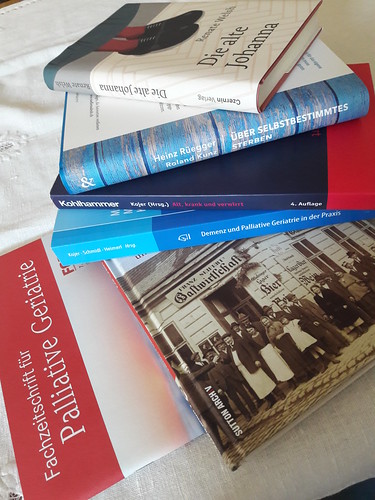
Hutter E., Lutz M.: Jung und Alt erzählen einander Geschichten vom Lebensende (Opens in new window)2025-09-17, Fachzeitschrift für Palliative Geriatrie10/02
-
Heimerl K., Hutter E., Pichler B., Dressel G., Reitinger E.: Storytelling Cafés about End of Life as Palliative Care Research Method (Opens in new window)2025-09-17, 8th Public Health Palliative Care International Conference Bern, Schweiz
-
Pichler B., Reitinger E., Hutter E., Dressel G., Heimerl K.: Erzählcafés zu "Geschichten vom Lebensende" aus der Perspektive von Klasse und Geschlecht (Opens in new window)2025-09-17, Gemeinsamer Jahreskongress DGGG & DGG 2024 "Altern ohne Grenzen" Kassel, Deutschland
-
Pichler B., Reitinger E., Hutter E., Dressel G., Heimerl K.: Erzählcafés zu "Geschichten vom Lebensende" aus der Perspektive von Klasse und Geschlecht (Opens in new window)2025-09-17, Gemeinsamer Kongress der DGGG & DGG 2024 Kassel, Deutschland
-
Hutter E., Dressel G., Pichler B., Reitinger E., Heimerl K.: Einblicke in Erzählcafés zu "Geschichten vom Lebensende" (Opens in new window)2025-09-17, Jahreskongress der ÖGGG 2025 Salzburg, PMU
-
Dressel G., Huttere E.: "Die Menschen brauchen manchmal nur jemanden, der da ist und zuhört" - Zuhören als hospizlich-palliative Praxis (Opens in new window)2025-09-17, die hospiz zeitschrift27/107
-
Hutter E., Pichler B., Dressel G., Reitinger E., Heimerl K.: Care cultures at the end of life - a narrative approach (Opens in new window)2025-09-17, Imaginaries and Strategies for Good Care and Good Housing in Times of Transformation Wien, WU
-
Pichler B., Dressel G., Hutter E., Reitinger E., Heimerl K.: Das Projekt SoKuL: Erzählcafés zu Geschichten vom Lebensende als Citizen Science Methode (Opens in new window)2025-09-12, Jahreskongress der ÖGGG 2024 Wien
-
Hutter E., Heimerl K., Pichler B., Dressel G., Reitinger E.: (Bisherige) lessons learned im Spannungsfeld zwischen Hierarchien und partizipativer Forschung, Drittmittelfinanzierung und der Entwicklung einer Qualifikationsarbeit. (Opens in new window)2025-09-12, Partizipative Forschung – Forschungswerkstatt Wien
-
Hutter E., Pichler B., Heimerl K., Dressel G., Reitinger E.: Das Erzählcafé als partizipative Forschungsmethode – eine kritische Diskussion (Opens in new window)2025-09-12, PAFOWE25 - Partizipative Forschungswerkstatt 2025 Wien
-
Pichler B., Heimerl K.: Geschichten von der Untröstlichkeit (Opens in new window)2025-09-12, Fachzeitschrift für Palliative Geriatrie2024/04
-
Pichler B., Dressel G., Hutter E., Reitinger E., Heimerl K.: Students’ response to the citizen science project SoKuL (Opens in new window)2025-09-12, ARPHA Proceedings2024/6
-
Hutter E., Heimerl K., Pichler B., Dressel G., Reitinger E.: Eine kritische Diskussion (Opens in new window)2025-09-12, CARN-D.A.CH-Tagung 2025 Wien
-
Barbara Pichler, Gert Dressel, Katharina Heimerl, Evelyn Hutter, Elisabeth Reitinger, Andrea Lorenz, Martina Hiemetzberger, Christina Hallwirth-Spörk, Günter Müller, Klaus Wegleitner, Raphael Schönborn: Das Erzählcafé als Citizen Science Methode: Wissensgenerierung, Bildung und Kommunikation (Opens in new window)2023-11-28, Österreichische Citizen Science Konferenz 2023 Linz, JKU
-
Katharina Heimerl, Evelyn Hutter, Barbara Pichler, Gert Dressel, Elisabeth Reitinger: Narratives about caring cultures at the end of life (Opens in new window)2023-11-28, Age and Care Universität Graz
-
Heimerl Katharina, Reitinger Elisabeth, Dressel Gert, Pichler Barbara: Von Erzählcafés und „small stories“ – Erzählen in Gruppen als Methode der partizipativen Forschung. (Opens in new window)2023-11-28, Aktionsforschung: Vergangenheit– Gegenwart – neue Zukunft. Praesens Wien315-328
-
Barbara Pichler, Gert Dressel, Evelyn Hutter, Elisabeth Reitinger, Katharina Heimerl: The Storytelling Café as a Citizen Science Method: generating knowledge, communication and educatio (Opens in new window)2023-11-28, PoS Proceedings of Science(ACSC2023) 016
 Schools
 Partners from Economy and Society
 Scientific institutions