
News: Inside Sparkling Science 2.0
In Sparkling Science projects, scientists conduct research on current research questions together with pupils. In many of these citizen science projects, other citizens are also involved, e.g. families, people with disabilities or medical professionals. Over the course of around three years, the participants work together in various project phases, e.g. when creating questionnaires or collecting and analyzing data.
To find out more about the projects, the news series “Inside Sparkling Science 2.0” offers regular insights into the project activities and the collaboration of the various citizen science participants as part of the monthly webinar series “Spotlights” and interviews.
Webinars "Spotlights"
From September 2023 to June 2026, researchers, together with participating teachers, presented their funded Sparkling Science projects during these one-hour online sessions held at lunchtime. They shared their experiences, challenges and lessons they had learnt.

The two Sparkling Science projects CO2 Conversion. From Harmful Exhaust Gas to Resource - CO2 as a Valuable Raw Material and Aquirufa: Biodiversity and Ecology of Freshwater Bacteria shared their experiences with the participants during the webinar on September 14, 2023 and talked about the cooperation with the participating schools. They talked about successes, challenges and adaptations in the course of their projects.

In the webinar on October 12, 2023, project managers and employees from various disciplines shared their experiences. On the one hand, Nora Dirisamer, Julia Lauss and Christoph Helm (Johannes Kepler University Linz) shed light on the topic against the backdrop of their Sparkling Science project "Circus of Knowledge. Citizen Science meets Citizen Art". On the other hand, Franziska Dengler (Vetmeduni Vienna) reported on her experiences from the project "Kolik & Butyrat. Panacea butyrate? Evaluation of production, effect and therapeutic potential in the colon of the horse".

How do citizen scientists learn to work scientifically? This question was explored in the third “Inside Sparkling Science 2.0 Spotlight” on November 9, 2023 from 12:00 to 13:00.
Two projects shared their experiences on the topic of “Training Citizen Scientists”. Friederike Barkmann (University of Innsbruck) from the Sparkling Science project Lebensraum Gründach and Fabian Pettig (University of Graz) from EAT+CHANGE presented their projects and lessons learned in the webinar. The active involvement of students, teachers and other citizen scientists raises exciting questions about methods, formats and materials with regard to the transfer of knowledge about scientific work.

Different people work closely together in citizen science projects - project staff meet teachers, pupils and other citizen scientists. Despite good planning, differences of opinion can arise. How can disagreements in the project be resolved effectively? What resources can you fall back on?
In the 4th Spotlight on December 14, 2023, two project leaders shared their experiences. Elena Ritschard (EDUCULT) reported on the project Colonialism today! What does that have to do with me? Hans Karl Peterlini (University of Klagenfurt) presented lessons learned from the Transform4School project.

The ongoing motivation of Citizen Scientists is an important factor for the success of a project. How are the achievements of citizen scientists recognized? What incentives work for teachers, students and other project participants to keep the motivation to participate in research high?
These and other questions were discussed in the 5th Spotlight of the webinar series “Inside Sparkling Science 2.0” on January 11, 2024. The current Sparkling Science projects VisibLL, represented by Barbara Soukup (University of Vienna), and WILDLIFE CRIME, represented by Silke Schweiger (Natural History Museum Vienna), presented themselves.

On March 14, 2024, two Sparkling Science projects presented their research and lessons learned. Charlotte Doll (Medical University of Vienna) from the Sparkling Science project “Be PART of it!” and Robert Vogler (University of Salzburg) from “u3Green” gave an insight into their research content and their collaboration with pupils as Citizen Scientists. Both projects deal with the living environments of children and young people - both in the context of the classroom and in the immediate urban environment.

Clemens Fuchs (University of Salzburg) from the Sparkling Science project “MAJA” and Wolfgang Schöner (University of Graz) from “Snow2School” gave an insight into their research content and collaboration with pupils as Citizen Scientists on April 11, 2024. They talked about mathematical algorithms, snow observations in Greenland and Austria and the lessons learned from the projects.

Ursula Gärtner and Sally Baumann (University of Graz) from the Sparkling Science project “LIDAL - Latin Inscriptions for Digital and Extracurricular Learning” and Sebastian Goreth (University of Teacher Education Tyrol) from “DIGIdat - Digital Data Analysis for Indoor Air Quality meets Education for Sustainable Development” gave an insight into their research content and collaboration with pupils as Citizen Scientists on May 8, 2024.
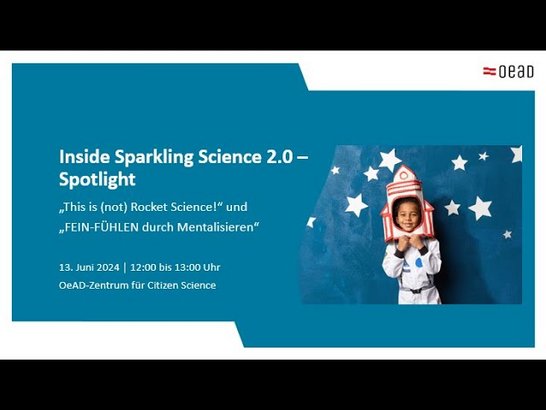
Doris Erhard and Sarah Rosenbichler (Technisches Museum Wien) from the Sparkling Science project “This is (not) Rocket Science” and Antonia Dinzinger (Paracelsus Medical Private University) from “Reflecting Minds - FEIN-FÜHLEN durch Mentalisieren” gave an insight into their projects on 13 June 2024. Both teams maintain a close exchange with the co-researching students and presented their working methods.

Georg Jäggle (Vienna University of Technology) from the Sparkling Science project “Recycling Heroes” and Renate Gehwolf and Andrea Wagner (Paracelsus Medical University) from “SparCling Matrix” gave an insight into their research content and collaboration with students as Citizen Scientists on September 12, 2024. From their work in recent years, they gave new citizen science projects tips for good collaboration.

On November 14, 2024, the projects Freeze For Future-Glacier Worlds and Biodiversity of Austria's Minnows were presented in the 12th “Inside Sparkling Science 2.0” spotlight. Johanna Trummer (University of Innsbruck) and Anja Palandacic (Natural History Museum Vienna) showed that school students can successfully conduct both field and laboratory research.
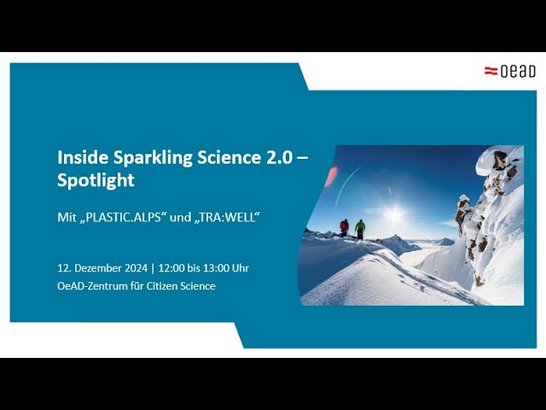
In the one-hour online session on December 12, 2024, two research projects funded by the Sparkling Science program presented themselves. The event offered insights into the research work of PLASTIC.ALPS (led by the University of Innsbruck) and TRA:WELL (led by BOKU Vienna) as well as valuable experience reports and “lessons learned”. The audience had the opportunity to actively ask the project leaders Dr. Birgit Sattler (University of Innsbruck) and Dr. Juliane Stark (BOKU) questions and exchange ideas.

In the Spotlight on January 16, 2025, Chiara Wang (University of Klagenfurt) presented the project “Relevance of Mathematics Teaching”, in which students research attitudes towards mathematics teaching as citizen scientists. Rebecca Weckenmann (University of Innsbruck) presented the project “Multilingual Spaces: Exploring and Transforming Multilingual Spaces”, in which research is being conducted together with prospective and current elementary school teachers.

On March 13, 2025, Edwin Herzberger (Federal Research Center for Forests) and Barbara Birli (Federal Environment Agency) presented the City-Tree-Soil project, which investigates the effects of the urban environment on tree growth and soil carbon. Hannes Schweiger, Miriam Weidl and Jelena Altomare (University of Vienna) presented the SAG S MULTI project, which is dedicated to promoting linguistic heterogeneity in schools and society.

In the Spotlight on April 10, 2025, Maria Lindhuber (University of Vienna) presented the BiodiverCITY-Island Hopping project, in which pupils from five Viennese schools are working together to plant insect-friendly plants on brownfield sites in Vienna, transforming them into “biodiversity islands”. Karin Liebhart (Institute for Conflict Research) presented CHANGE, in which citizen scientists at partner schools in four federal states are co-creatively developing research questions relating to various forms of social inequality.

In the spotlight on May 8, Irene Gianordoli (Federal Research Center for Forests) presented the “Forest Groove” project, which builds a bridge between nature and music in an innovative way and makes the biodiversity of the forest audible to a wide audience. Marlene Wagner and Andrea Schlager (University for Continuing Education Krems) presented “Hybrid teaching-learning spaces in schools”, where the conditions for success and potential of hybrid learning environments are being investigated in close cooperation with four commercial academies in the Waldviertel region.
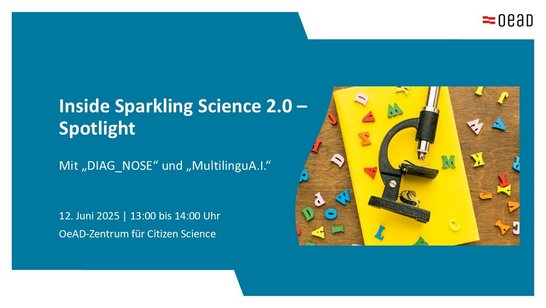
Paulina Wagner and Julia Renner (University of Vienna) reported on their project “MultilinguA.I.” on June 12, 2025. This investigates the use of Large Language Models (LLMs) in foreign language teaching using the examples of French and Chinese. Gabriele Gadermaier and Johanna Rehrl (University of Salzburg) presented “DIAG_NOSE”, which aims to simplify allergy diagnostics by identifying markers in non-invasive molecular biological samples.
Interviews
To learn more about the projects, "Inside Sparkling Science 2.0" offers regular insights into the project activities and the cooperation of the different citizen science participants.
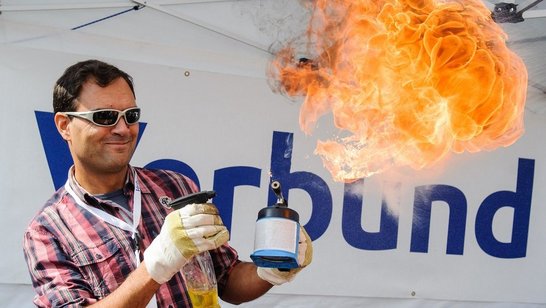
Learning about microbes is easier with science communication
In this video interview, science communicator Bernhard Weingartner (Vienna University of Technology) reports on how students in the Sparkling Science project Micro-Tramper communicate science, gives tips for successful science communication and tells how to counter skeptics.
Read more

Microbes in food production - teenagers sample cheese and kitchens
In the video interview, the project manager of the Sparkling Science project "Micro-Tramper" talks about why she and her team decided on the citizen science approach and what her best moment so far has been with the young people in the project. She also discusses, among other things, what remains at the schools after the project ends. In addition, one of the students herself has her say and talks about her own impressions.
Read more
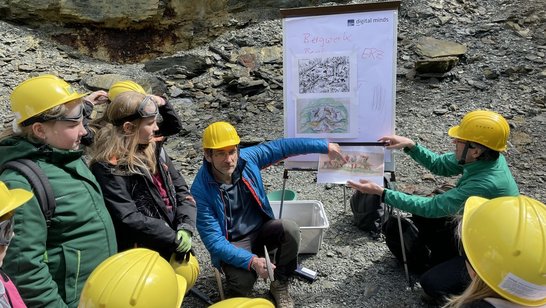
Elementary school children do research on regional raw materials for a sustainable future
In the citizen science project One day there will be… researchers work with elementary school children on the topic of sustainable use of raw materials. Prof. Robert Kamper (PH NÖ) explains in a video interview why pupils can participate at such a young age, what advantages this brings and what they are dealing with.
Read more
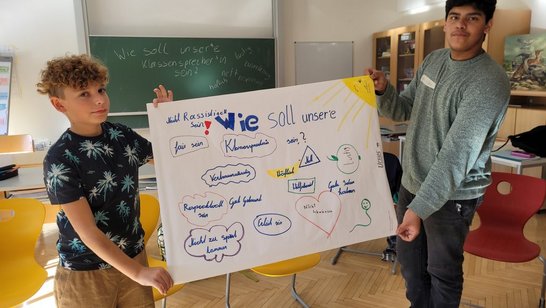
Class councils and student parliaments for more democratic learning in schools
In the interview, the project leader Hans Karl Peterlini (University of Klagenfurt) talks about the motivation behind his project Transform4School, what democracy learning can achieve and how the students participate.

Visually impaired students collaborate on technical innovations for physical education classes
In the video interview, Arnold Baca (University of Vienna) answers a series of questions about his Smart Sport Assistance project, which involves the development of assistance systems. These are intended to make it easier for visually impaired students to participate in sports lessons.
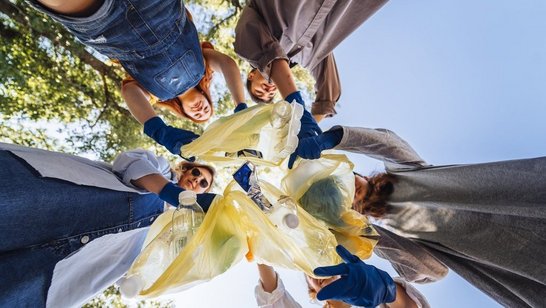
Garbage everywhere you look! Tracking down environmental pollution with citizen science
In this interview, glacier researcher Birgit Sattler (University of Innsbruck) and technology expert Munir Merdan (bee produced) talk about how they are using their Sparkling Science projects PLASTIC.ALPS and Recycling Heroes to combat plastic waste and e-waste and support environmental protection.
Read more

Science communication with and for children and teenagers
In the interview, project leader Philipp Spitzer (University of Graz) explains, among other things, what is planned in the citizen science project We talk about science, which highlights he is particularly looking forward to and what science communication means to him personally.