
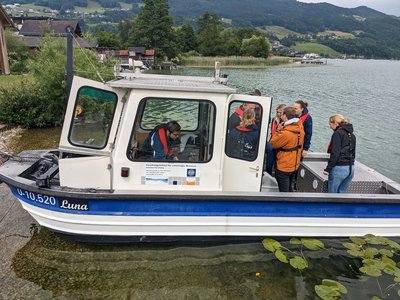
A new film on the topic of biodiversity has been produced as part of the research project ‘Aquirufa: Biodiversity and Ecology of Freshwater Bacteria’. It shows that biodiversity includes much more than the diversity of visible animal and plant species – microorganisms such as bacteria also play a central role in the functioning of ecosystems.
The Sparkling Science project focuses on the bacterial genus Aquirufa, which was originally discovered and scientifically described in collaboration with schoolchildren. This group of bacteria, which is widespread in freshwater environments, is an important component of aquatic ecosystems. Since 2022, researchers from the Research Institute for Limnology Mondsee (University of Innsbruck) have been working with citizen scientists to investigate its distribution, biodiversity and ecological significance in waters in Salzburg and Upper Austria (Austria).
The project builds on its predecessor project ‘The Hidden World of Bacteria’ which was funded by Sparkling Science between 2017 and 2019. In the Citizen Science project, schoolchildren succeeded in isolating new species of bacteria from local waters and describing them scientifically. Both research projects highlight the vast and yet unexplored diversity of microbial life even in our immediate surroundings, and especially in lakes and water.