
KI–WATER project activities strengthen the collaboration of Kabale University and BOKU University
KABALE, Uganda — September 2025. Kabale University, in partnership with BOKU University’s Institute for Hydrology and Water Management, organised a series of collaborative activities in the framework of the KI-WATER Project – Building Regional Capacities in Integrated Water Resources Management in the Kigezi Highlands. Held from September 16 to 19, 2025, these engagements underscored the commitment of both institutions to advancing research, training, and community engagement for sustainable water management in the region in line with our project objectives.
Meeting with Kabale University Management and Equipment Handover
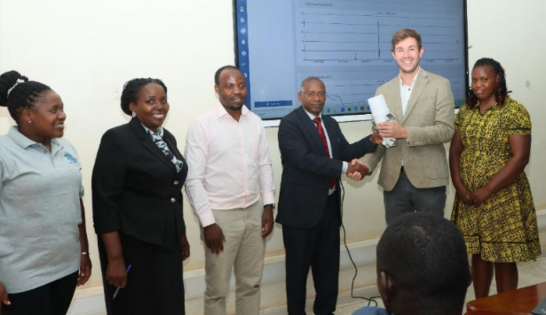
During the visit of Gabriel Stecher from BOKU University, the KI-WATER project team met with Kabale University management to present the project objectives. Led by the Deputy Vice-Chancellor (Academic Affairs), the meeting included deans, department heads, and officials who viewed the partnership as a strategic move to strengthen environmental sciences at Kabale University and the Kigezi region. A notable moment was the official handover of new research tools procured within the KI-WATER project, including an automated weather station and two high-precision water quality measurement instruments, to the Department of Environmental Sciences.
The weather station (ATMOS 41W) observes 13 hydro-meteorological variables including precipitation, temperature, solar radiation, and relative humidity, among others, and transmits the observed data to an online server in real time. The station will be installed at the Kabale University Campus to observe key hydrological variables during and beyond the project duration. The two water quality measurement devices are able to detect key water quality parameters, including pH, Electrical Conductivity, Total Dissolved Solids, Water Temperature, Salinity, and Oxidation-Reduction Potential. These water quality measurements provide essential information for integrated water resources management in the region.
These devices will improve environmental monitoring in the Kigezi Region during and beyond the KI-WATER project activities by providing reliable data for teaching and research purposes. The meeting with Kabale University management and the procurement and handover of the equipment contribute to several project outcomes, including an integrated assessment of the regional hydrology and water quality and the improvement of research and teaching capacities in integrated water resources management at the university level.
Stakeholder Inception Workshop: KI-WATER
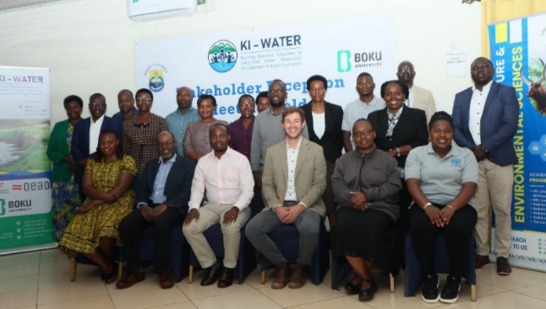
The stakeholder inception meeting brought together over 25 participants, including district water officers, local government leaders, NGOs, and students from the Kigezi Region. The aim was to present the KI-WATER project. The presentation focused on outlining the project's activities and objectives, coordinating institutional roles, and promoting inclusive participation. The lively discussion with local stakeholders on the project activities resulted in valuable feedback on the planned activities. The stakeholders appreciated the clear project outline and design while recognizing the importance of achieving the project's objectives.
Beyond the planned project activities, participants in the workshop recommended additional areas of interest including agro-economic aspects of soil and water conservation and wetland restoration. Stakeholders are dedicated to working closely with the project team to support the objectives and develop a deeper understanding of integrated water resources management in the Kigezi Highlands. The stakeholder inception meeting was also covered in the national newspaper and aims and project activities were broadcasted by the local radio station – Voice of Kigezi. This activity contributed to the project outcome of integrating local knowledge into integrated water resources management in the region.
Field visit and selection of water quality monitoring sites
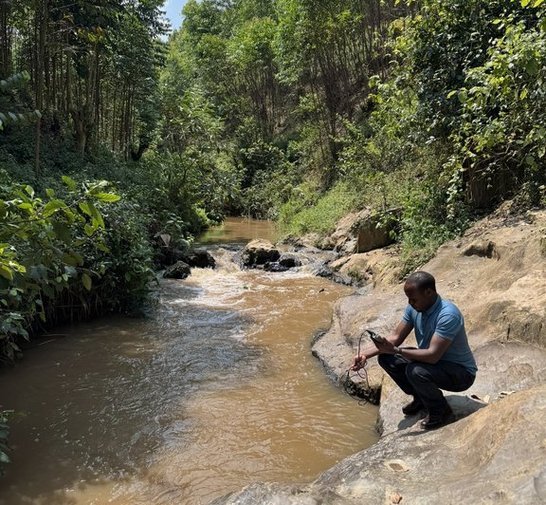
The two-day field visit to the Maziba and Ruhezamyenda sub-catchments allowed the joint team to assess flow and water quality conditions in the region. This visit aimed to evaluate newly procured water quality testing equipment and select monitoring sites along streams and rivers for ongoing assessment of water resources. Pre-tests verified that all devices functioned correctly and provided the Kabale University team with hands-on experience in operating procedures for upcoming monitoring efforts.
During the field campaign, water quality was observed at multiple streams and rivers to identify locations for the project's monitoring program. The project team selected 13 strategically located sites across the Lower-Maziba (7 sites) and Ruhezamyenda (6 sites) sub-catchments for continuous monitoring. The selected sites, include surface waters in urban, rural and pristine areas, allowing to attribute catchment activities with water quality conditions.
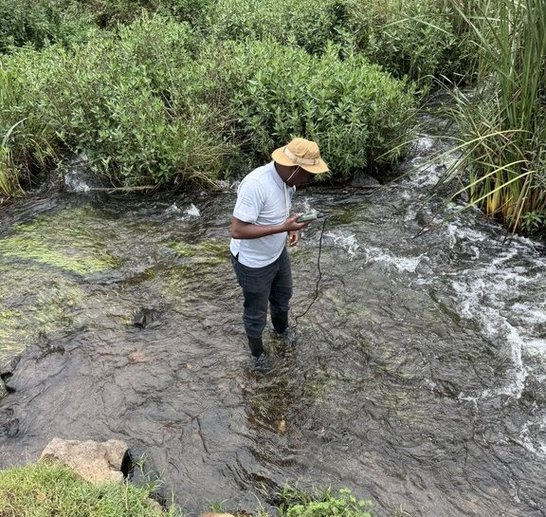
Monitoring at these sites will include key parameters such as pH, Electrical Conductivity, Total Dissolved Solids, Water Temperature, Oxidation-Reduction Potential, and nutrient levels including various forms of Nitrogen and Phosphorus. The results will enhance our understanding of surface water quality conditions and reveal potential threats and drivers of water resources degradation in the region. This baseline information is especially crucial because data on water quality is usually scarce in rural Ugandan catchments.
The monitoring campaign and water quality analyses shall be partly carried out within master thesis research projects by Kabale and BOKU University students, enhancing their technical competencies in field sampling methods, analytical techniques, and data interpretation while building research capacities for independent water resources assessment.
Lecture on discharge measurement
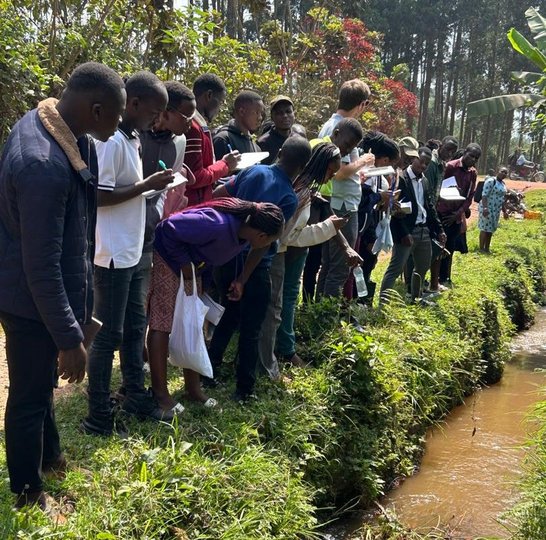
During his visit, Mr Gabriel Stecher, a hydrologist from BOKU University, delivered an engaging lecture titled "Discharge Measurement Methods – Salt Dilution" to 25 second-year Environmental Science students. The session introduced the fundamentals of discharge estimation as a catchment response, highlighting how the salt-dilution method can accurately measure streamflow in ungauged tributaries. He used practical examples to show how flow measurements indicate changes in land use, climate, and upstream management, underlining their importance for hydrological monitoring.
This streamflow measurement method has not been previously taught at KAB and represents a significant extension of the Integrated Water Resources Management curriculum. A field activity in the nearby stream around Kabale University supplemented his lecture. During the field activity, students gained first-hand experience in applying the streamflow measurement technique themselves. This interactive approach provided practical insights that support the project's goal of improving field-based IWRM skills and strengthens students' capacity for comprehensive water resources assessment.