
Clean and Prosperous Uganda – Fecal Sludge and Solid Waste Management for Improved Livelihoods | CPUg

Project Coordinator: Therese Schwarzböck
Coordinating Institution: Vienna University of Technology (TU Wien)
Partner Institutions: Makerere University (Jeninah Karungi-Tumutegyereize); Uganda Red Cross Society (James Mundrugo); Mbarara University of Science and Technology (Elias Oyesigye)
Partner Country: Uganda
Project Duration: 1 March 2022 – 31 August 2026
Budget: EUR 518.823
Project Overview
Fecal sludge management (FSM) and solid waste management (SWM) are consistently recognized as being insufficient in many areas within Uganda. Oftentimes, the management of these two categories of waste are organized separately and executed with insufficient resources, political will, and funding. Nevertheless, there are many opportunities for value chain creation and valorization of materials, micronutrients, and energy content contained within solid waste and fecal sludge, especially when considered together. The project team will explore circularity concepts, test a variety of techniques for utilizing dried fecal sludge (e.g., co-firing, co-composting), and target national plastic waste management (e.g., analyzing plastic recovery and recycling paths). Through which, this project aims to examine how to best optimize and integrate FSM and SWM in urban settings in Wakiso District, refugee settlements in Arua District, and for Uganda more broadly.
The results of such work are expected to:
- Improve waste-related knowledge gaps
- Build capacities of stakeholders at the university and municipal level (e.g., local authorities and service providers); and
- Change perceptions of fecal sludge-derived products by end-users (primarily subsistence and commercial farmers).
These actions, in turn, are expected to improve upon the livelihoods of many Ugandans, to include women and refugees, by reducing their exposure to harmful pollutants and pathogens, all while sustainably creating new economic opportunities in recycling, composting, and energy recovery.
Key Outputs
- Teaching infrastructure and methodology enriched by new resources and lessons learned
- Use of FS experiments and of agricultural experiments to pursue FS value chain creation in Arua and/or Wakiso District
- Draft recommendations for improved composting products, plastics recovery, and RDF production
- Selected students are involved in project and working on their research projects
- Discussions about implementation of gender perspectives within the project
- Dissemination activities are constantly revised, adopted, implemented, and reported
- New software tool WaPla+ for trainings and for publishing piloted
- Trainings are implemented (both practical FS-product trainings and macro-level, integrated FSM and SWM trainings)
Reporting
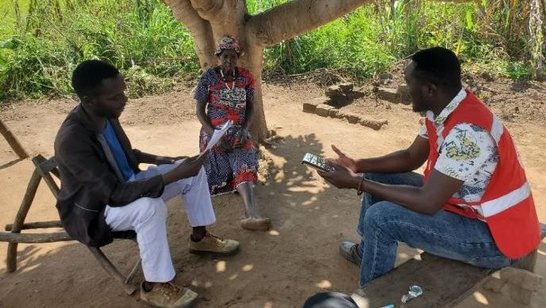
CPUg | Report on the 1st project year | (March 2022 - February 2023)
CPUg team members have been hard at work trying to make Uganda “cleaner and more prosperous”, as its project title explicitly states. The project is aimed at improving fecal sludge and solid waste management capabilities across the country, with a particular focus on the Imvepi refugee settlement in the northwest part of the country; urban and suburban settings within Wakiso District; and 2-3 selected CDM composting plants throughout the country.
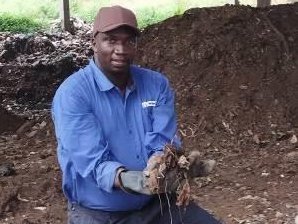
CPUg | Report on the 2nd project year | (March 2023 - February 2024)
Another busy project year on the books for APPEAR project, “Clean and Prosperous Uganda – Fecal Sludge and Solid Waste Management for Improved Livelihoods”. Where to start?
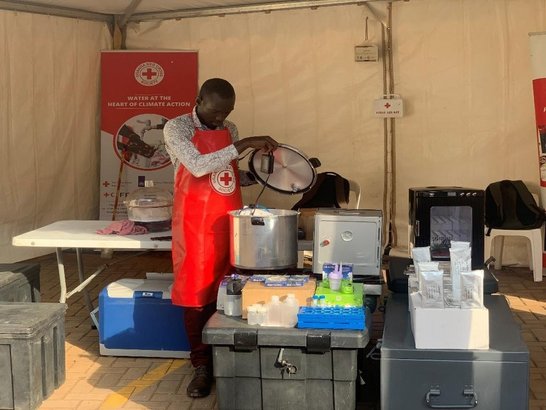
CPUg | Report on the 3rd project year | (March 2024 - February 2025)
At the end of the third year of the project, the project team can present many outputs, both in research and in teaching. All participating institutions - TU Wien, Makerere University, Mbarara University of Science and Technology an Uganda Red Cross Society, report significant results.
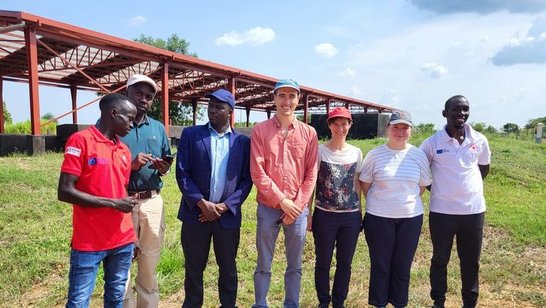
For the better part of June 2024, three researchers from TU Wien’s Institute of Water Quality and Resource Management were in Uganda, carrying out a number of activities alongside their partners to help meet the project objectives. Read more.