Let’s start with Makerere University, along with Mbarara University of Science and Technology. In January 2025, two master’s students, Agnes Nalunga and Daniel Okaso, and five bachelor’s students, Joan Nalunga, Daisy Nantume, Cecilia Nansiimbi, Phionah Tumuhairwe, and Rachael Kunihira, graduated under the auspices of CPUg. They experimented on different aspects of Black Soldier Fly Larvae composting, biochar production from fecal sludge, anaerobic co-digestion, vermicomposting, and evaluated the acceptability of fecal sludge composts. From their collective efforts, one publication has been submitted to a peer-reviewed journal and others are under internal review for eventual submission. Agnes Nalunga expressed immediate interest in continuing with her PhD and received an APPEAR scholarship for just that purpose soon thereafter. She will be tackling microorganisms in disposal sites that show promise for metabolizing plastic polymers and is in the process of legalizing her documents for admission to the TU Wien. The other students in the project have made significant progress as well, including PhD students, Elisa Basika, Medard Kakuru and Elias Oyesigye, investigating biochar from co-pyrolysis, conducting socio-economic studies, and evaluating maize-based cropping systems, respectively. Makerere also played host to a number of delegations. First, the TU Wien and the Austrian Development Agency in June 2024, for the project’s consortium meeting to share experiences, project mandates, and expected outcomes. Second, to APPEAR office and multiple OeAD officials in January 2025, for the purpose of showcasing project results and progress, along with presenting the administrative and financial management structures of the university. Finally, the MU Biosystems Engineering research team, led by Dr. John A. Komakech, continued to collaborate well with URCS in Imvepi refugee settlement in the capacity building of 18 staff and volunteers there on vermicomposting and other waste management protocols.
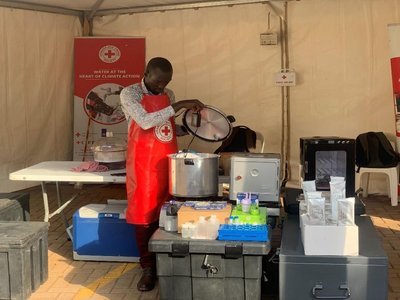
As part of URCS’s ongoing commitment to improving sanitation and hygiene in vulnerable communities, their team participated in the World Toilet Day Celebration held at Imvepi Refugee Settlement in collaboration with the UNHCR, Office of the prime minister & Water Mission Uganda. This event served as a platform to raise awareness about the importance of proper sanitation, sustainable waste management, and innovative toilet solutions for refugee communities. A key highlight of URCS’s participation was the demonstration and promotion of the Gulper Pit Emptying Technology, an innovative and low-cost solution designed to enhance fecal sludge management in areas with limited sanitation infrastructure. The technology was showcased to stakeholders, community members, and humanitarian organizations, emphasizing its effectiveness in improving public health and environmental sustainability. Their efforts were enhanced by support from researchers from Makerere University.
TU Wien has been moving right along with its objectives as well. Since last year’s leap day (February 29th), APPEAR PhD scholarship holder, Francis Okori, has completed his course requirements, completed his compost laboratory analysis on microplastics, and submitted his second scientific paper to a peer-reviewed journal. Sara Neuburg (alongside Francis) has carried out her second waste sampling campaign at the Mukono and Masindi composting plants and has been hard at work in the lab preparing and analyzing those samples. Richard Lee and Therese Schwarzböck accompanied Sara in Uganda for two of those four weeks, to attend the aforementioned consortium meeting, a CPUg students’ symposium, and two round table discussions with sewage and fecal sludge management stakeholders from Terego and Wakiso districts. They even managed to schedule visits with Victoria Nile Plastics, a major plastics (recycling) company, and Hima Cement, one of Uganda’s most well-established cement producers and the African continent’s premier implementor of alternative fuels in its firing kilns. Both companies are potential recipients for sieve residues of Sara’s research. Richard started into his doctorate, already producing the first draft of his first paper and finalizing the data collection survey for his second paper. Finally, the WaPla+ fecal sludge management software programming has been initiated and made progress, thanks to TU Wien’s Manuel Hahn.
Within the next months, apart from analyzing the collected data and diligently writing publications, the project team will gear up to implement trainings on improving and integrating solid waste and fecal sludge management in Terego and Wakiso.
With new developments happening on a weekly and monthly basis, there’s never a dull moment in the team's collective efforts to provide for a “Clean and Prosperous Uganda”. The project's LinkedIn page will keep you updated on the latest.
Project website of Clean and Prosperous Uganda – Fecal Sludge and Solid Waste Management for Improved Livelihoods | CPUg.