MICROPLASTICdays is an annual conference convened by PLANTERASTICS, a microplastic research group at the Faculty of Chemistry and Chemical Technology, University of Ljubljana, Slovenia. It is not just a conference, but a collective endeavor to drive meaningful change and address the growing issue of global microplastic pollution. MICROPLASTICdays bring together experts, stakeholders, and the public to facilitate knowledge exchange and enhance collaboration in microplastic research.
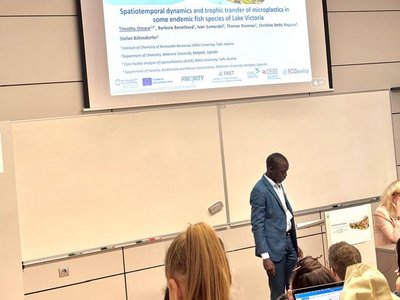
Timothy Omara presented his doctoral research findings titled: Spatiotemporal dynamics and trophic transfer of microplastics in some endemic fish species of Lake Victoria at MICROPLASTICdays 2025. The study investigated the presence of small-sized plastic particles (microplastics) in three fish species from Lake Victoria as well as potential transfer of microplastics through the food chain.
This study examined microplastic occurrence in three fish species commonly consumed from Lake Victoria: Lake Victoria sardine, Lake Victoria Squeaker and African lungfish, sampled from Ripon Falls, Katosi, and Port Bell fish landing beaches. No microplastics were found in the sardines, edible muscles and gills of the other two species. However, the intestines of all the squeakers and lungfish contained microplastics, with up to 16 plastic particles per fish in the dry season. Most plastics were blue and brown, measuring between 0.3 mm and 0.9 mm in size, and mainly composed of nylon and polypropylene. The study found no direct evidence to support that microplastic transfer is occurring between small and large fish in Lake Victoria. Most importantly, all the microplastics were only found in fish intestines which are typically removed before consumption, suggesting that the risk of human exposure to microplastics from consuming these fish species is minimal.
MICROPLASTICdays 2025 provided our PhD scholar a platform to exchange analytical experiences, appreciate the on-going standardization efforts and attend practical demonstrations in the analysis of microplastics using techniques that are not readily accessible at BOKU. Timothy also took part in the practical workshop and discussion on the use of artificial intelligence in microplastics analysis using Hufnagl Chemometrics microparticles AI software, which deepened his understanding of microplastic analysis based on hyperspectral imaging and machine learning. This exposure was also invaluable in guiding his last research objective, which will explore sustainable strategies for microplastics remediation from Lake Victoria.
Timothy Omara is a doctoral candidate at the Institute of Chemistry of Renewable Resources, University of Natural Resources and Life Sciences, Vienna (BOKU) and an Assistant Lecturer of Chemistry (contract position) at Makerere University, Uganda. His PhD research, supervised by Prof. Stefan Böhmdofer, is embedded in the APPEAR funded project Environmental Chemistry for Sustainable Development | ECSDevelop. The doctoral research focuses on investigating the sources, seasonal variations, trophic transfer and removal of microplastics in the Ugandan portion of Lake Victoria. Prior to joining BOKU in 2023, Timothy worked as an Analyst and Deputy-in-Charge of the Chemistry Division (Food Safety Laboratories) of Uganda National Bureau of Standards, Mbale Branch. He holds a Master of Science in Analytical Chemistry obtained from Moi University (Kenya) under the World Bank-funded Center of Excellence in Phytochemicals, Textile and Renewable Energy (ACE II PTRE).