Environmental Chemistry for Sustainable Development | ECSDevelop
Project coordinator: Christine Betty Nagawa
Coordinating institution: Makerere University, Kampala
Partner institutions: University of Natural Resources and Life Sciences, Vienna (Stefan Böhmdorfer) and Jaramogi Oginga Odinga University of Science and Technology (Solomon Omwoma Lugasi) with participation of Kyambogo University
Partner countries: Uganda, Kenya
Project duration: 1 January 2022 – 31 December 2024 (36 months)
Budget: EUR 373.050,15
Project Overview
East Africa faces serious environmental challenges in relation to atmospheric, soil and water pollution. The Lake Victoria basin and the Albertine Graben have not been spared either. The Lake basin, which is being shared by Uganda, Tanzania and Kenya has undergone rapid urbanization in the last three decades; coupled with the high population density, rapid industrial growth and waste-water treatment plants in vicinity of Lake Victoria basin have been reported as sources of environmental contaminants such as plastic debris and endocrine disrupting chemicals (EDCs). Aquatic ecosystems such as Lake Victoria have been reported as endpoints to plastics of all sizes, including microplastics. The harmful effects of microplastics such as starvation, death, oxidative damage, developmental defects and neurotoxicity to organisms have been reported. However, studies on the extent of microplastics pollution in freshwaters such as Lake Victoria and River Nile are limited; we shall investigate the seasonal fluxes, sources and trophic transfer of microplastics within the aquatic ecosystem of Lake Victoria and River Nile.
Petroleum exploration and production activities have been carried out in the Albertine Graben which leads to accidental oil spills; these oil seepages lead to environmental degradation and thus impose threats to people’s health through food chains. Many bioremediation and chemical oxidation studies have been carried out but with limited remediation efficiency. In this project, we shall explore multifaceted application of nanotechnology in the field of bioremediation of petroleum hydrocarbons. Understanding the interaction between the contaminant, the microorganism, and the nanomaterials is of crucial importance since positive and negative effects may be produced.
Project objectives
The overall objective of this project is to increase the capacity and contribution of environmental chemistry research in higher education in order to address the local and global priority needs in improving water quality and advancement of remediation technologies
It is expected that through this project, we shall;
- Exploit regional capacities to jointly streamline existing curricula on environmental chemistry and ecotoxicology.
- Develop a novel cost-effective state-of-the-art technology to track and clean up contaminants in waste water using locally available resources such as Moringa oleifera and other plant materials.
- Develop efficient remediation technologies for crude oil contaminated soils and water of the Albertine graben, Uganda.
- Investigate seasonal fluxes, sources and trophic transfer of microplastics within the aquatic ecosystem of Lake Victoria and River Nile.
Project results
The project intends to train 5 PhD and 4 MSc graduate researchers distributed as follows
- 2 PhD and 2 MSc students at Makerere University
- 1 PhD and 1MSc at Kyambogo University
- 1 PhD and 1MSc student at Jaramogi Oginga Odinga University of Science and Technology).
- 1 PhD student will be directly funded by APPEAR
Impact and sustainability of the project
The currently taught curriculum is more theoretical in scope. Graduates have limited hands-on experience which would be required for the current job market. In this project, the curriculum in Environmental Chemistry and Ecotoxicology will be established, that is practical oriented and addresses the increasing societal challenges in environmental pollution and climate adaptations. In this new curriculum, the use of modules, drama and audio-visual teaching aids to include the special needs group will be emphasized to demystify the abstract aspects of chemistry.
Through networking, institutions in East Africa and the European Union will work together through staff-student exchanges to provide the necessary expertise in research and innovations that are demand driven towards the national challenges in environmental pollution. Publications, patents and policy briefs arising from research results will form an important baseline for new knowledge and/or technologies to be adopted
The project intends to equip the local farmers with the relevant skills to boost the production of Moringa and gooseberries, which will be a sustainable source of the scaled-up bioremediation technologies.
This will in the long run contribute to:
- environmental conservation in the Lake Victoria basin and the Albertine graben,
- improved livelihoods among the farmers through sales of Moringa and gooseberries thereby reducing poverty, and
- improved health of the community by consuming clean water.
Reporting
Report on the 3rd project year | (January 2024 - December 2024)
As we draw closer to the end of the project we are happy to report that all our students are in the final stages of writing there dissertations. During this reporting period we have managed to publish over 6 articles from our findings while other articles have been through collaboration with other scientists in the region and abroad. We are hopeful that by December all our project activities will be finalised.
We have began the bioremediation experiments from which we hope to design a filter, from this prototype we can submit our innovation for filing and once funds allow we shall produce a few to showcase the findings.
Through North- South and South –South exchange our students have also been able to access modern laboratory facilities which have also increased their exposure. One of our MSc students, Silver Odongo is now working as an assistant lecturer at Lira University. This is one of the areas of capacity building from which we have benefitted a lot.
Report on the 2nd project year | (January 2023 - December 2023)
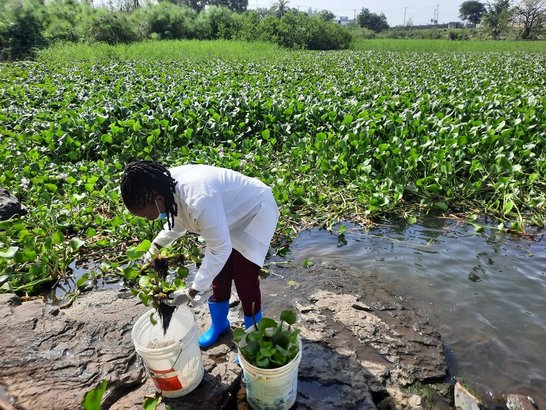
During the reporting period, the ECSDevelop project continued to advance its research and capacity-building activities. Field sampling and laboratory analyses were carried out at all major study sites, and MSc and PhD students made substantial progress toward completing their research. Several training workshops, exchange visits, and outreach activities were implemented in Uganda, Kenya, and Austria, supporting knowledge transfer and community engagement. Updated curricula in analytical chemistry are close to approval, and the project team produced new scientific publications and manuscripts. Two student-led innovations were patented in Kenya, and partners successfully secured additional external research grants. Collaboration within the consortium remained active through joint supervision, coordination meetings, and shared methodological development. Overall, the project is progressing as planned, with remaining work focused on final analyses, dissemination activities, and completion of dissertations.
Report on the 1st project year | (January 2022 - December 2022)
During the reporting period, several key activities have taken place that have brought us closer to our project goals. One of these was the development of the project website, which is continuously updated to keep track of current project activities. The ECSDevelop project website has gained both local and international views, with our readers constantly contacting us about the new opportunities in the project. Both past and current project activities can be followed on our website.

Discharge of plastics into Lake Victoria. The breakdown of these plastics produces microplastics and nanoplastics which are major pollutants of water. The end products end up in sediments, water and aquatic life.
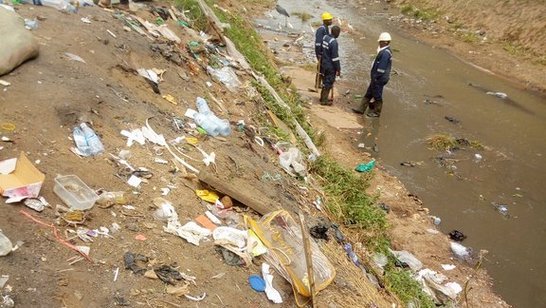
Improper disposal of both solid and effluent from industries and the communities contributes to the contamination of water bodies.