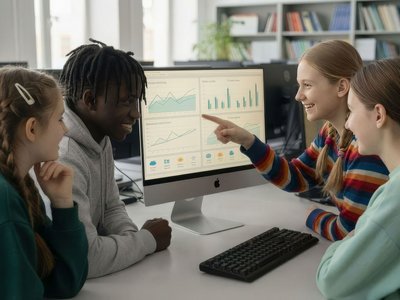
Was there more snow in the past during the winter? Were the summers when our grandparents were teenagers already this hot? What information about climate change can be found on Instagram, TikTok, and other platforms, and does it match scientifically measured data? The Citizen Science Award project “Climate Agents” explores these and many other questions. Citizen scientists can participate in the research in two ways: They conduct interviews in their own communities to document personal observations of the effects of climate change and compare these with measured climate data. Or they use AI methods to analyze social media posts to identify narratives and spatial patterns in the context of climate change.
Since the start of the research participation period on April 1, several webinars and online workshops with school classes have taken place to provide an optimal introduction to the research activities. In addition to a project presentation, the focus was on the two research participation options. The project team provided an interview guide, including a structured template for conducting the interviews, as well as a collection of Austrian social media posts on the topic of climate change for AI analysis, and explained the necessary steps.
The project team provides ongoing support to the participating school classes until the end of the collaborative research period and is currently developing an assessment tool to measure the learning outcomes of the citizen scientists. A feedback loop with the participating classes is also planned. This will involve collecting feedback on the materials provided in order to optimize them as needed.
Both the citizen scientists and the scientific community benefit from this collaborative research: The citizen scientists gain insights into scientific methodologies and become an active part of the research process by making a concrete contribution. The researchers, in turn, receive a wealth of data to document local climate changes and can use this to develop potential solutions.
Interested school classes, youth groups, families, and individuals can actively participate in the research until July 31!
Click HERE for more information about the project.