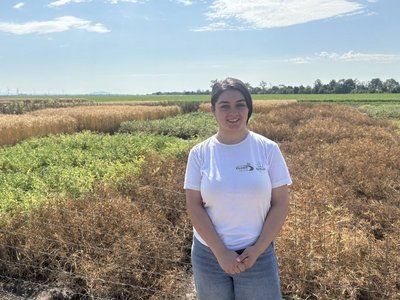
Mariam Mardanyan is an agroecologist from the Tavush region of Armenia. She earned her Bachelor’s degree in Agroecology (2015–2020) and subsequently a Master’s degree in Organic Agriculture (2020–2022) from the Armenian National Agrarian University. Her Master’s studies were supported by the APPEAR Project Building Organic Agriculture in Armenia | BOAA, and she was among the first graduates of the programme.
From 2022 to 2025, she worked as an agronomist and assistant project coordinator at “Green Lane” NGO. In parallel, she served as a workshop specialist at the Yerevan Botanical Garden, contributing to environmental education and hands-on training activities.
In 2025, she was awarded a PhD scholarship within the subsequent APPEAR project Strengthening Organic Agriculture in Armenia: Participatory Higher Education and Knowledge Exchange for Development | SOAA. Since March 2025, she has been conducting her doctoral research at the University of Natural Resources and Life Sciences, Vienna (BOKU).
Her PhD research, titled “Effect of irrigation on growth, yield, yield components, nitrogen uptake, nitrogen fixation, and radiation use efficiency of grain legumes,” is based on a two-year field study conducted at the BOKU experimental farm in Groß-Enzersdorf. The experimental design includes wheat, lentils, peas, fava beans, and chickpeas. Throughout the growing season, weekly field measurements are collected, including plant height, phenological development, plant health status, and leaf chlorophyll content. Laboratory analyses of grain yield and dry matter are being conducted to assess yield components and nitrogen uptake.
The PhD research is supervised by Associate Professor Reinhard Neugschwandtner, who has worked in the field of agriculture for around 20 years. It is also worth mentioning that he has visited Armenia several times as an exchange teacher, including through the SOAA programme.
The primary objective of her research is to evaluate how irrigation influences productivity, nitrogen dynamics, and radiation use efficiency in grain legumes, and to identify which crops perform best under irrigated conditions and which are better adapted to low-input or rainfed systems.
This research is highly relevant for Armenia, Austria, and the global agricultural community. Grain legumes are central to sustainable farming systems: they improve soil health, fix atmospheric nitrogen, reducing the need for synthetic fertilizers, lower greenhouse gas emissions, and play a vital role in crop rotations.
Beyond environmental benefits, legumes are essential for human nutrition. They provide rich sources of plant-based protein, fiber, iron, folate, magnesium, and antioxidants, contributing to food security and the prevention of malnutrition and chronic diseases. In the context of global population growth, regional conflicts, climate change, and increasing water scarcity, legumes are expected to play an even more significant role in resilient agricultural systems.
Through her doctoral research, Mariam Mardanyan aims to generate scientifically robust insights into irrigation management and legume performance, supporting more sustainable, resource-efficient, and climate-resilient farming systems worldwide.