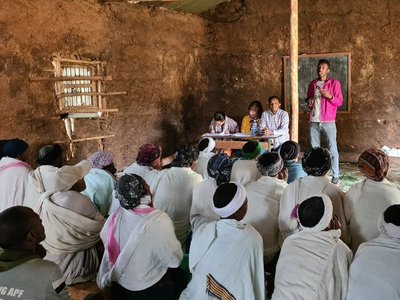
The OeAD-funded KoEF project Rural Women's Right to Access to Land in North-West Ethiopia: Challenges and Limits addresses persistent gender inequalities in land access. Despite the establishment of normative and institutional frameworks intended to prevent discrimination, women in North-West Ethiopia continue to face human rights denials rooted in traditional and social customs. These violations are further exacerbated by patriarchal social structures and male-dominated land administration systems in the study area.
The primary objective of this empirical research is to reduce gender inequalities and improve women’s well-being by systematically identifying and analysing the challenges, limitations, and current status of women’s land access rights in North-West Ethiopia.
The study employs mixed research methods (qualitative and quantitative) and was conducted through a close North-South partnership between Debre Markos University (DMU), Ethiopia, and the BOKU University Vienna, Austria. Another key objective was the prolongation of this partnership through the joint application of advanced research methodologies, data analysis, and the sharing of knowledge and skills. Activities also included workshops, community seminars and training sessions, which were helpful in initiating a shift in mindset regarding traditional laws.
The project officially began with a foundational Workshop and Field Study (March 11–20, 2023) at the Debre Markos University in Ethiopia. During the workshop the groundwork for the critical assessment of women’s land rights was developed and elaborated.
Subsequent primary data collection in 2023 and 2025 were carried out by Ethiopian colleagues. The investigations involved extensive interviews and surveys with female farmers (married, divorced, windowed, unmarried); Key informant interviews with rural land administrative office authorities, women affairs officers, judges, legal aid providers and justice Officers, female land administrative committees’ members; Focus Group Discussions (FGDs) with land administration officers, rural women and men farmers and a review of legal documents to assess the legal framework's adequacy. These “Reality Check” phase faced delayed progress due to the armed conflict in the Amhara region. Necessitating adaptive measures to ensure researcher safety and data integrity were taken.
The culmination of these field efforts and legal analysis is the elaboration of two publications. The first investigated the legal framework in Ethiopia and in the Amhara Region in particular to check if the existing land Rights are supporting women’s access to land. The second is based on the fieldwork and give evidence that – despite existing law – customary practices still constrain rural women’s land rights in the study area (East Gojjam Zone of Ethiopia).
Besides the two publications, the objectives, the activities and the findings of the research project were disseminated using various mechanisms including the workshop at the Debre Markos University and institutional websites. In addition, the project was presented during a workshop dedicated to "Women’s Land Rights". This workshop was organized by the Institute and Cluster of Development Research (BOKU University) and funded by the Austrian Developing Agency.
This research project contributes towards SDGs with a focus on gender equality (SDG 5). The research project also contributes to SDG1: No poverty; SDG 2: Zero hunger; SDG3: Good health and well-being, SDG10: reducing inequality within and among countries; SDGs 17: Strengthen the means of implementation and revitalize the global partnership for sustainable development.