
6th Call
The 6th KoEF Call for funding is open from 1 September 2025 until 30 November 2025, 13:00 pm CET.
Due to the regulations set by the Special Guideline on the “Maßnahmen zur Internationalisierung/Measures for Internationalisation” (GZ: BMBWF-2024-0.205.097) of the Federal Ministry of Women, Science and Research (BMFWF), which was published in 2024, only Austrian Higher Education Institutions or Austrian Research Institutions are able to submit and coordinate a project. However, as in previous years, project consortia must consist of at least one Austrian public university or research performing institution and at least one partner institution in the Global South. Therefore partner institutions in the Global South are eligible as project partners.
Applications can only be submitted via the StipOnline portal. The basic data for the project must be entered in this portal and the completed application documents uploaded.
You can find the Guidelines for the 6th Call, the Application Templates and the link to the StipOnline portal in the column on the right.
Application Process | September 2025 – November 2025
Only researchers (PhD holders) affiliated with an Austrian public university or research performing institution are eligible for application, submission and coordination of a project. The project coordinator that submits the project proposal will also assume overall responsibility for coordinating the project and for reporting. The funds are to be handled via a bank account of the institution.
Minimum qualification for the project coordinator is a PhD. All participating researchers must either be PhD students or PhD holders. Master's students are not eligible to participate.
Researchers from at least one public university or research performing institution located in Austria and one state-accredited university or research performing institution in any country of the Global South classified as “least developed countries”, “other low income countries” and “lower middle income countries and territories” (excl. India) as defined in the DAC-list of the OECD 2022/2023 must be involved in each project.
- Applications have to be submitted via the StipOnline portal before the deadline.
- Deadline: 30 November 2025, 13:00 pm CET
Promote International Collaboration
- Support research partnerships between Austrian institutions and institutions in the Global South.
Address Sustainable Development Goals (SDGs)
- Align research projects with SDGs, contributing to both local challenges and broader international development objectives.
Foster Equitable Partnerships
- Ensure meaningful contributions from all partners in terms of knowledge, resources, and effort.
Encourage Interdisciplinary Approaches
- Support projects that integrate diverse perspectives and methodologies to solve complex problems.
Create Long-term Impact
- Establish a foundation for sustained international collaboration, including follow-up projects and joint publications.
Support New Research Projects
- Focus on initiating new research efforts.
Promote Mutual Learning and Innovation
- Facilitate the generation of knowledge to tackle urgent global challenges effectively.
- Project duration: 24 months
- Maximum funding amount: 40,000 euros per project
- Earliest possible start of the projects: July 2026. Latest possible start: December 2026.
Please note: KoEF project funding is only intended as a grant and is not designed to cover the entire costs of the project. As stipulated in the Special Guideline on the “Maßnahmen zur Internationalisierung/Measures for Internationalisation” (GZ: BMBWF-2024-0.205.097) the grant recipient must ensure the implementation of the project through the use of appropriate own funds. This must be clearly presented in the financing plan. If no own funds are indicated in the financing plan, the application will be considered incomplete and will not meet the formal eligibility criteria.
Only the following expenses can be requested for funding by KoEF:
Incoming mobility | travel to Austria from a partner country in the Global South
Travel costs to Austria. The cheapest reasonable means of transport must be chosen. The financing only covers the journey to the partner institution in Austria and back home. No further travel financing is provided. A maximum of 2,000 euros per person per trip can be reimbursed. This includes only the following:
- Flight costs including airport taxes: cheapest option, economy class only. Fees for the reservation of certain seats cannot be reimbursed. CO2 compensation cannot be reimbursed. Costs for visa, travel insurance and vaccination cannot be reimbursed.
- Travel costs to and from the airport. In Austria only public transport.
- Allowance for the stay: Daily allowance of no more than EUR 180 per day spent actively working on the project during the stay in Austria. However, the maximum monthly allowance is capped at EUR 2,160 per month (1 month = 30 days). Thus, the maximum amount is EUR 2,160 per month. The maximum duration per person per stay is three months (i.e. three times EUR 2,160 = EUR 6,480 total allowance). No further costs related to the stay can be reimbursed.
Outgoing mobility | travel from Austria to the partner country in the Global South
Travel costs to the partner country in the Global South. The cheapest reasonable means of transport must be chosen. The financing only covers the journey to the partner institution in the Global South and back home. No further travel financing is provided. A maximum of 2,000 euros per person per trip can be reimbursed. This includes only the following:
- Flight costs including airport taxes: cheapest option, economy class only. Fees for the reservation of certain seats cannot be reimbursed. CO2 compensation cannot be reimbursed. Costs for visa, travel insurance and vaccination cannot be reimbursed.
- Travel costs to and from the airport. In Austria only public transport.
- Allowance for the stay: Daily allowance of no more than EUR 180 per day spent actively working on the project during the stay in Africa. However, the maximum monthly allowance is capped at EUR 2,160 per month (1 month = 30 days). Thus, the maximum amount is EUR 2,160 per month. The maximum duration per person per stay is three months (i.e. three times EUR 2,160 = EUR 6,480 total allowance). No further costs related to the stay can be reimbursed.
Material costs
- Material (consumables), only if they are essential and specifically relevant for the project, can be covered up to a maximum amount of 5,000 euros for the entire project duration. Only consumables can be reimbursed, e.g.: test kits, chemicals, research permit, data acquisition, vehicle rent for field research, publication costs. No infrastructure or basic equipment can be reimbursed, e.g.: no laptops, no telephone or internet costs, no staff costs, no honoraria for participants. Overheads are not acceptable and must not be included.
- Applications have to be submitted via the StipOnline portal before the deadline.
- Deadline: 30 November 2025, 13:00 pm CET.
- Please note that the application must be submitted in English.
The project is applied for via the StipOnline portal. The basic data for the project must be entered in this portal and the application documents uploaded. The documents to be uploaded are:
- Project Proposal (pdf)
- Abstract (pdf)
- Financing Plan (excel file)
- CV of the Project Coordinator (pdf)
- Letters of Endorsement of ALL participating institutions (as one pdf)
Application documents can be downloaded from the section on the right. The templates for the project proposal and the financing plan, which can be found in the download section on the right, must be used. Please copy the abstract from the project proposal and upload it as a separate pdf document. You may use or adapt the templates for the CV of the project coordinator and the letters of endorsement to suit the needs of the respective project coordinator/institution. However, ensure that all relevant content is included as stated in the respective template.
Reviewing and Selection | December 2025 - May 2026
The KoEF Office at OeAD will check whether the formal requirements of the project applications have been met.
Formally correct proposals will be evaluated by independent reviewers between January and April 2026. In accordance with the Ministry's regulations, two expert reviews will be obtained to form the basis for the ranking list.
The reviews will consist of a scoring matrix (max. 100 points) and narrative assessments. Evaluation criteria will be:
- Project Design and Scientific Quality, Cooperation and Partnership (max. 50 points)
- Contribution to the SDGs and Added Values (max. 20 points)
- Results and Sustainability (max. 20 points)
- Risk Management and Cost-Effectiveness (max. 10 points)
Ranking on the basis of the average score of the reviews (maximum score 100).
The list of selected projects has to be approved by the BMFWF. This is envisaged to take place in June 2025.
Earliest possible start of the projects: July 2026. Latest possible start of the projects: December 2026.
Reporting and Disbursements of Funds
The project duration is 24 months.
Earliest possible start: July 2026. Latest possible start of the projects: December 2026.
Disbursement of funding to the institutional account (no disbursement to private accounts).
A disbursement of 50 per cent of the funding per project is made to an account of the coordinating institution after the contract has been signed. Further 25 per cent are disbursed after approval of the mid-term report. The remaining max. 25 per cent of the project budget will be transferred after approval of the final report. If the budget is not used in full by the end of the project, the remaining amount must be refunded to KoEF Office/OeAD-GmbH.
The mid-term as well as the final report must include a scientific and a financial report. The reports have to be in English and have to be submitted by the project coordinator within 2 months after the end of the reporting period. Failure to report will automatically result in the termination of the KoEF project and the requirement to return undocumented funds to OeAD.
Presence at the research location is mandatory for all projects; failure to comply may result in the termination of the project and reclaiming of funds.
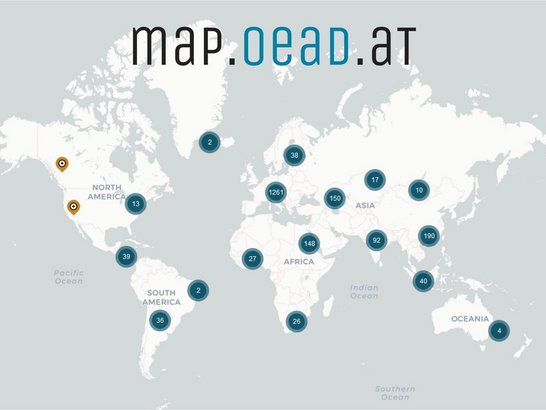
Visit the oead.map to visualize the projects funded through the Cooperation Development Research programme!