
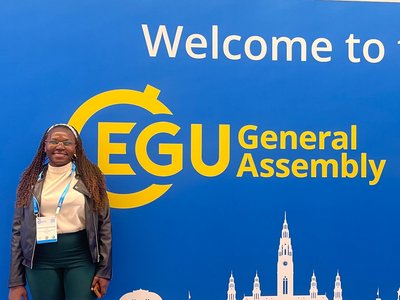
Florence’s presentation was titled: “Drivers of stream metabolism in anthropogenically disturbed mountainous streams of Uganda.” Her research investigates how natural and human-induced factors such as elevation, deforestation, agriculture, and urban development interact to influence stream metabolism in tropical highland regions. Using data collected over seven months in 11 headwater streams in western Uganda, she explored how land use and elevation control key metabolic processes like gross primary production (GPP) and ecosystem respiration (ER) which are essential indicators of freshwater ecosystem health and functionality.
Findings from the study revealed that both local scale variables (like stream width, canopy cover and sediment nutrients) and catchment level drivers (like land use composition and elevation) significantly affect stream energy dynamics. This work highlights the sensitivity of tropical montane streams to anthropogenic pressures and supports efforts to integrate functional indicators into freshwater monitoring strategies. Read more in this abstract.
The conference also provided Florence with valuable opportunities to engage with aquatic ecology researchers, discuss integrative methods in stream health assessment, and explore future collaborations focused on tropical freshwater ecosystems.
Florence Nansumbi is a PhD candidate at the University of Natural Resources and Life Sciences Vienna (BOKU) based at the Institute of Hydrobiology and Aquatic Ecosystem Management. Her research is supervised by Prof. Thomas Hein and focuses on the use of ecosystem functions as indicators of freshwater ecosystem integrity. Florence previously worked as a research assistant at Makerere University, Uganda, and holds a joint MSc in Marine and Lacustrine Science and Management from Vrije Universiteit Brussel, the University of Antwerp, and Ghent University. This interdisciplinary training demonstrates her strong commitment to advancing freshwater sustainability in East Africa.