
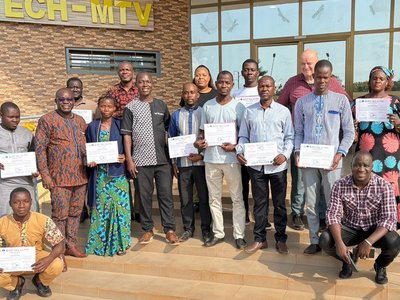
During the five-day programme, 15 participants, including Master's and PhD students as well as postdoctoral researchers, received hands-on training in a variety of topics, ranging from conventional breeding systems to community-based breeding approaches. They were also introduced to the analysis of genomics data, including diversity studies and genome-wide association studies (GWAS), and learned how these tools can be applied in modern breeding programmes.
International collaboration
The course featured expert instructors from BOKU University and the University of Veterinary Medicine Vienna in Austria, as well as from Université Nazi BONI, Université Norbert ZONGO, and Université Joseph KI-ZERBO in Burkina Faso. This collaborative approach enriched every session with diverse perspectives and fostered a strong spirit of cooperation. Fomer APPEAR scholarship holders Prof. Albert Soudré and Dr Dominique Ouédraogo made significant contribution to the course with their epertise. Prof. Soudré presented the context of the course and the APPEAR project LoCaBreed2.0 while, Dr Ouédraogo in addition to coordinating the pratical organization of the course, introduced participants to the concept of community-based breeding programs.
A foundation for the future
More than just a knowledge-sharing event, this summer school helped build local and regional capacity, strengthen professional networks, and promoted sustainable genetic improvement tailored to local contexts. The outcomes of these five days exceeded expectations. As a first edition, the summer course was a The outcomes of these five days exceeded expectations. For a first edition, the summer course was a resounding success, setting a solid foundation for future, larger-scale summer schools that will be open to participants from other West African countries and beyond.