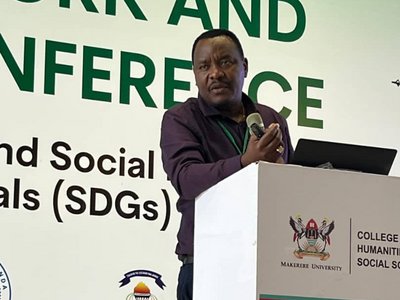
The International Conference on Social Work and Social Development took place at Makerere University in Uganda from 16–18 June 2025. The theme was: 'Building Resilient Communities to Promote Equity and Social Inclusion for the Attainment of Sustainable Development Goals (SDGs)'.
The event brought together a diverse group of participants, including academics, researchers, practitioners and students from a range of backgrounds and levels of experience. It provided a dynamic platform for the exchange of knowledge, experiences and innovative practices aimed at addressing global social challenges. Participants reaffirmed their commitment to collaborating to generate knowledge, advance social justice and strengthen the resilience of communities worldwide. The event emphasised the critical role of interdisciplinary dialogue and shared learning in promoting equity and achieving sustainable development.
Charles Rutikanga presented a paper 'Survival Strategies of Street Children in Rwanda: Discovering Their Resilience in Coping with the Rough Realities of Street Life'. His field research data on street children in Kigali reveals a multifaceted reality characterised by extreme vulnerability, yet marked by notable resilience and complex coping strategies. These children navigate a precarious urban environment, often disconnected from family structures and lacking access to basic necessities. The findings emphasise the intersection of poverty, social exclusion and systemic neglect as the main causes of their involvement in street life. Street children in Kigali commonly engage in informal and unstable economic activities, such as acting as car guards, begging and selling leftover or small-scale produce (e.g. fruit and vegetables). Though minimal and often exploitative, these income-generating efforts constitute essential survival strategies.Their exclusion from mainstream economic and social systems is exacerbated by their frequent experience of stigma, harassment and discrimination at the hands of both their peers and the wider public.
The data also show that most street children are exposed to significant health and safety risks, including physical abuse, sexual exploitation and a lack of shelter. They often spend nights in insecure public spaces, which exposes them to assault and environmental hazards. Malnutrition is widespread, and access to medical care is often limited or non-existent. Mental health issues, particularly trauma, anxiety and depression, are common, often exacerbated by substance abuse, including marijuana use, glue sniffing and inhaling petroleum-based products. Despite these challenges, the data highlight strong indicators of resilience among street children. Many form informal peer support networks that function as surrogate families, offering emotional support, mutual aid, and a sense of security. These networks serve as grassroots social protection systems in the absence of formal institutional or family support. Children demonstrate ingenuity and agency by engaging in various informal jobs, such as scavenging for rubbish, collecting metal scraps, and guiding vehicles, often in violation of cooperative rules which restrict such work to registered members.
Girls, in particular, face gender-based vulnerabilities, with some resorting to transactional sex as a survival strategy. At the same time, street children develop psychological defence mechanisms, such as adopting a hardened identity or 'street persona', in order to cope with the chronic trauma of rejection and marginalisation. Many children express a desire to be reintegrated into society, hoping to return to school, find decent employment and build stable family lives. However, their resilience is largely reactive, driven by immediate survival needs rather than transformative. Therefore, the findings underscore the urgent need for coordinated interventions by government institutions and non-governmental organisations to address the root causes of vulnerability and support the transition from survival-based resilience to long-term well-being and social reintegration.
Charles Rutikanga has been a lecturer in social work at the University of Rwanda since 2009, based in the College of Arts and Social Sciences. He is currently pursuing a PhD in Development Studies at the University of Vienna under the supervision of Prof. Petra Dannecker. He holds a Master's in Social Work and Social Administration from Uganda Christian University, as well as a Bachelor's in Social Work from the former National University of Rwanda. He is the African regional representative on the IFSW Indigenous Commission. Prior to entering academia, he worked with Health Poverty Action, a UK-based NGO, in both junior and senior roles. He has participated in several major international research projects, including PROSOWO &funded by APPEAR; the Synthesizing Indigenous and International Social Work project; the Linnaeus Palme Project; the UR-SIDA Programme; the NORHED II Resilient Project; and the GETSPA project. He has also served as a visiting lecturer at Tulane University, Makerere University, Carinthia University of Applied Sciences and Gothenburg University. His research interests include child protection, development studies and social work. He continues to play a vital role in advancing social work education and research in Rwanda and beyond.