As a young student of Geodesy, I took the decision to spend one semester at TU Wien. During my Erasmus stay in Vienna, I got to know the high standard of education at TU Wien and became very interested in working in an international group of students, doctoral candidates and scientists at the former Institute of Geodesy and Geophysics, now restructured to Department of Geodesy and Geoinfomation.
The task of geodesy is to determine the size, shape, gravity field and rotation of the Earth as a function of space and time. Geodesy involves measuring and understanding the Earth’s geometric and physical properties, including determining exact locations, developing coordinate systems for mapping, navigation and Earth observation, monitoring the Earth’s gravity field, measuring variations of the Earth rotation tracking the movement of tectonic plates and surface deformation, measuring sea level changes, ice melting and global water cycle, detecting environmental changes. We geodesists often say that geodesy is the most fundamental, most important science that nobody's ever heard of. This invisible science powers everything we take for granted yet remains unknown to the very people who depend on it. The International Association of Geodesy (IAG), established in 1862, is a global scientific organization promoting geodesy research and cooperation, which has evolved from a regional initiative to an international association, emphasizing collaboration in solving geodetic challenges.
At the end of my Erasmus semester at TU Wien, I was offered a very interesting (but also challenging) topic for my potential master thesis aiming to estimate geophysical parameters from space geodetic technique measurements. While searching for scholarship opportunities, I came across the open call for the Austria Student Scholarship, which was initiated by Dr. Veit Sorger and was offered by the Mondi Austria Privatstiftung. I was one of the few students to be awarded this scholarship, for which I consider myself very lucky. As an undergraduate student without any own income, it enabled me to live in Vienna and focus entirely on my master's studies and research at TU Wien. The support of the Mondi Austria Foundation managed by OeAD continued also during my following doctoral studies where I gained experience with analyzing data from Very Long Baseline Interferometry (VLBI).
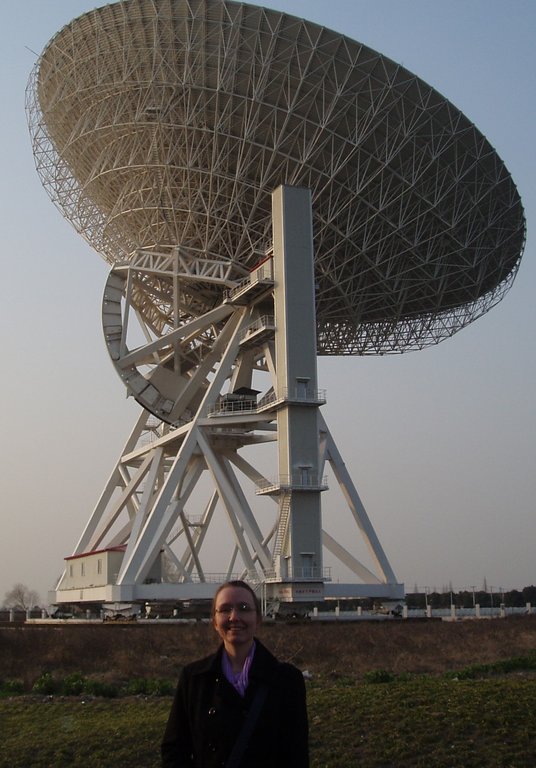
VLBI is a space geodetic technique based on radio astronomy. Radio signals emitted by active galactic nuclei are captured by a pair of telescopes located on the Earth’s surface. Due to the different position of the antennas, the same signal arrives at each antenna with a slight time difference. This time delay is measured to a precision of picoseconds with sophisticated atomic clocks installed at each antenna. By multiplying the time delay with the speed of light, the distance between the two antennas can be determined with an accuracy of few millimeters. Simultaneously, the precise positions of the extragalactic radio sources can be estimated which realize a stable space coordinate frame needed for example for spacecraft navigation or for determination of precise difference between an instantaneous Earth rotation and atomic time.
Since my employment at TU Wien in 2011, I have held a number of academic roles in the Department of Geodesy and Geoinformation. In 2013, I was honored as a first female geodesist with the Karl Rinner Prize from the Austrian Geodetic Commission for my research. Consequently, I was awarded an FWF Hertha Firnberg Excellence Fund grant which allowed me to conduct research with the focus on Earth-based VLBI in the Galactic frame. The findings of my research have been regularly published in prestigious international scientific peer-reviewed journals. Furthermore, after demonstration of my scientific qualification and the required didactic abilities I was awarded the Habilitation degree based on the habilitation thesis entitled “Global reference frames from VLBI”.
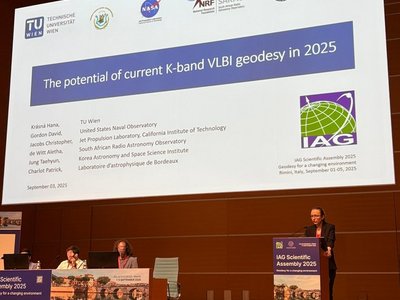
Presently, I hold the position of an associate professor at TU Wien where I am also the head of the VLBI group, a group which is recognized in the world-wide scientific VLBI community as being amongst the world's leading research groups in this field through their constant international visibility. The strong, close and productive collaboration with international partners (for example NASA - Jet Propulsion Laboratory, United States Naval Observatory, South African Radio Astronomy Observatory, University of Tasmania, ETH Zurich, University of Bordeaux) is illustrated by the joint journal publications and conference presentations. Furthermore, I am active in several international expert committees, including working groups of the International Association of Geodesy, the International Astronomical Union, and the International VLBI Service for Geodesy and Astrometry, where I have currently been elected to the Directing Board.
I am thankful to OeAD, the Erasmus program and the Mondi Austria Privatstiftung for their support during my early studies from 2007 to 2011, which didn’t only enable me to establish my scientific career but also to conduct the space geodetic research at the top international level today, thus gaining visibility and recognition for TU Wien.
What should incoming students expect when they start to study at TU Wien? Austrian universities in general expect students to manage their own studies – the students often choose courses themselves. The semester system can feel relaxed at first but exams often cluster at the end. So, I recommend studying consistently during the semester to avoid last-minute cramming. For students it is also their responsibility to ensure that they are aware of and adhere to all relevant deadlines. In my opinion, the key qualities for success as a student in Vienna are self-discipline, cultural adaptability, curiosity and a positive can-do attitude. Even though there are several master programs given in English, knowing a bit of Austrian (!) German helps with day-to-day life and getting to know Austrian students. Regarding the icebreaker conversion topic, I recommend to chat about the Austrian alpine skiers. Spending a winter semester in Austria will make you (at least in theory) an expert on the differences between the various ski racing disciplines such as slalom, giant slalom, Super-G or downhill.
LinkedIn: https://at.linkedin.com/in/hana-kr%C3%A1sn%C3%A1-019722131