
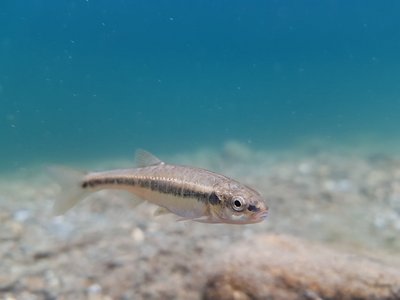
Minnows are small schooling fish that inhabit cold, oxygen-rich flowing and still waters. For a long time, scientists assumed that there was only a single, widespread species in Europe: the European minnow. Today, however, it encompasses an entire species complex, which currently comprises over 25 genetic lineages, including 13 recognised species.
To better understand the distribution and diversity of minnows and to protect them sustainably, the Sparkling Science project ‘Biodiversity of Phoxinus minnows’, led by a scientific team at the Natural History Museum Vienna, brought together researchers, school students and recreational anglers between 2022 and 2026. Together, they collected fish samples from water bodies across Austria, analysed them genetically and subsequently evaluated the results.
The findings, recently published in a peer-reviewed scientific journal, show that the citizen science project was able to confirm the distribution of several naturally occurring and introduced species in Austria. Of particular note is the discovery of a new species in Austria, Phoxinus cf. Morella, although it remains unclear whether this species occurs naturally or has been introduced through human activity.
Furthermore, the research team led by Anja Palandačić also provided important methodological insights: on the one hand, it was demonstrated that the involvement of citizen scientists can significantly expand the spatial coverage of data collection; on the other hand, eDNA analysis was found to be a promising approach for studying fish species in the future on a large scale, cost-effectively and using non-invasive methods. Overall, the results highlight the great potential that citizen science holds for biodiversity monitoring in Austria.