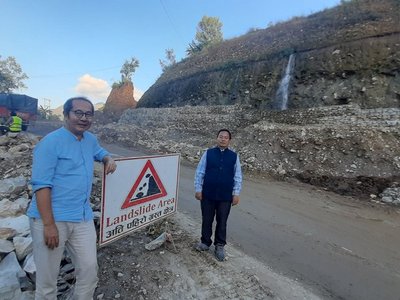
The mountains of the Himalayan belt are seismo-tectonically active, and the major natural hazards and risks in the Nepal Himalaya are landslides, debris flows and slope failures. The geo-environmental conditions of Austria and Nepal are similar, and natural disasters are occurring more frequently. The slope failures in Nepal are mainly due to frequent extreme weather events, rugged topography, earthquakes and human intervention. Several landslides occur during the summer monsoon season each year. Landslide events are not routinely recorded, and many slides, especially in remote locations, go unreported.
Landslide inventory mapping and analysis are underway at various institutions in Nepal to identify the root causes of the increasing trend in landslide frequency and impacts. Hillslopes are more susceptible to landslides because of parametric changes such as climatic variability (i.e. sudden rainstorms). Recently, the expansion of highways and increasing rural road construction without sufficient understanding of the fragility of hillslopes have led to a significant increase in landslides and slope failures along road-cut slopes. As a result, suitable risk reduction strategies are indispensable for addressing landslides and slope failures in mountainous terrain.
To provide protection solutions, the recently completed KoEF project Promotion of an Innovative and Green Slope Protection System focused on research into sustainable slope failure control options by observing and analysing different cases at actual sites to identify the probable causes and potential solutions of slope failures. Understanding the local geology and environment is crucial for developing cost-effective technology as a risk reduction measure. A combination of green slope protection systems, either with or without additional structural protections (e.g. soil nailing), forms part of this low-cost technology.
The green slope stabilisation technique is a nature-based solution that strengthens the soil mass and reduces slope failures through the use of living plants, occasionally in combination with non-living components. It is an eco-friendly alternative to conventional approaches, suitable for cut slopes and shallow landslides. To ensure reliable construction practice and to achieve it in a more cost-effective and environmentally appropriate manner, the right choice and careful design of soil nails are crucial concerns in slope failure prevention.
The applicability and sustainability of the slope protection system have been verified under extreme events (cloudbursts) such as heavy rain during monsoon dynamics. The research also demonstrated that the system is a nature-based solution that protects slope vegetation and controls gully erosion. The results are based on numerical modelling by adjusting geotechnical parameters and vegetation root reinforcement, which represents one of the innovative and quantitative methods for advancing green slope technology in the Himalayan terrain, in contrast to the trial-and-error approach of practitioners' subjective judgement.