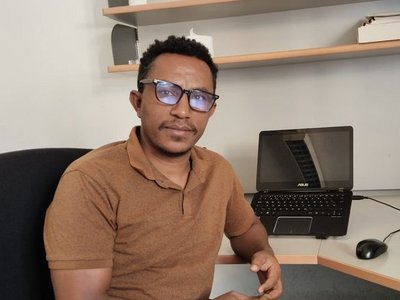
Abera Tilahun Abdi is a PhD candidate at the Institute of Forest Ecology, Boku University of Natural Resources and Life Sciences. His doctoral research examines agroforestry systems and multipurpose tree species across southern and southwestern Ethiopia, focusing on carbon sequestration, woody plant diversity along elevation gradients, and the physiological responses of trees to water stress and nursery treatments. His work quantifies soil and biomass carbon across land-use types and elevations, measures stomatal conductance and leaf/hydraulic traits of dominant multipurpose species, and evaluates how nursery-stage treatments affect seedling survival after planting. These results aim to inform sustainable land-use decisions and help policymakers promote agroforestry as a nature-based solution for climate mitigation and enhancing rural livelihoods.
From his PhD research, he has published the article “Soil carbon to go: Agroforestry practices including coffee sequester the highest amounts of soil C in mountainous Southern Ethiopia” in Agroforestry Systems (Springer) — a peer-reviewed international journal (journal metrics: JIF and established SJR values). The paper finds that coffee-based agroforestry systems hold the highest soil organic carbon stocks in the studied landscape, and that most total carbon is stored in soils rather than in woody biomass. This PhD contributes directly to APPEAR’s thematic priority on “protection of the environment and sustainable management of natural resources — mitigating climate change and its impacts” by generating locally actionable evidence on carbon storage, biodiversity, and climate-resilient planting practices in Ethiopian agroforestry landscapes.
In addition to his PhD work, Abera has co-authored another peer-reviewed paper outside his core PhD project, which nevertheless resonates strongly with APPEAR’s goals. The article “Gender roles in agroforestry value chains: evidence from fruit tree-based agroforestry in Dodota district, Ethiopia,” published in Frontiers in Sustainable Food Systems, examines gender dynamics in agroforestry value chains in Ethiopia (Kassaye et al. 2025). This work highlights the importance of social dimensions (e.g., gender equity, participation) in achieving sustainable and inclusive agroforestry systems — a key aspect relevant to development interventions under APPEAR.
Abera Tilahun Abdi received a BSc degree in Horticultural Science from Mekelle University and a Master’s degree in Forestry from Hawassa University, Ethiopia. Before his PhD studies, he worked as a researcher and Lecturer at the Wondo Genet College of Forestry and Natural Resources, Hawassa University, Ethiopia.
Publications:
Abdi, A.T., Kassa, B.A., Tesfay, H.M., Sandén, H. and Rewald, B., 2025. Soil carbon to go: Agroforestry practices including coffee sequester the highest amounts of soil C in mountainous Southern Ethiopia. Agroforestry Systems, 99(7), pp.1-16. https://doi.org/10.1007/s10457-025-01298-2
Kassaye, K., Kassa, G. and Abdi, A.T., 2025. Gender roles in agroforestry value chains: evidence from fruit tree-based agroforestry in Dodota district, Ethiopia. Frontiers in Sustainable Food Systems, 9, p.1448956. https://doi.org/10.3389/fsufs.2025.1448956