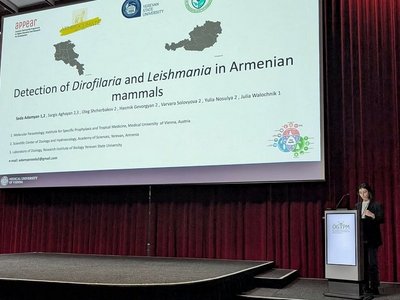
Seda Adamyan attended the ÖGTPM (Austrian Society for Tropical Medicine, Parasitology and Migration Medicine) conference in Graz, Austria, from 27-28 November 2025. This event brought together leading researchers and professionals in parasitology, tropical medicine, and public health to discuss advancements in diagnostics, disease control, and broader scientific collaborations.
Seda delivered an oral presentation titled "Detection of Dirofilaria and Leishmania in Armenian mammals". This study explored the prevalence of Dirofilaria and Leishmania species across multiple host species in Armenia, including golden jackals (Canis aureus), foxes (Vulpes vulpes), domestic dogs, and brown bears (Ursus arctos). The presentation received positive feedback and sparked engaging discussions about the role of wildlife reservoirs in zoonotic disease circulation, the significance of spatial overlap between infected domestic and wild animals, and the importance of integrated surveillance approaches in the South Caucasus region. It also opened opportunities for potential collaborations with researchers working on similar vector-borne diseases in neighboring countries. Her PhD research takes place within the framework of the APPEAR ArmBioClimate project.
Objectives for Attending the Conference
The conference featured numerous insightful talks and presentations covering a wide range of topics, from clinical tropical medicine to vector biology and international collaborations. This year's programme highlighted emerging zoonotic diseases, novel diagnostic approaches, and the importance of One Health frameworks in understanding disease transmission dynamics across wildlife, domestic animals, and human populations. Key highlights included presentations on vector-borne diseases in Central Europe, molecular diagnostic advances for parasitic infections, and wildlife surveillance studies demonstrating the interconnected nature of pathogen circulation between wild and domestic animal populations.
The main objectives for this participation were: to present findings from her research on zoonotic parasites in Armenia, particularly focusing on Dirofilaria and Leishmania species across multiple mammalian hosts, and to share the implications for public and animal health under a One Health framework, to gain insights into the latest diagnostic techniques and research methodologies that could be applied to her ongoing Ph.D. research, and to network with leading researchers, exchange ideas, and explore potential collaborations, especially in expanding her research to include additional wildlife species and vector ecology aspects.
Abstract
Vector-borne parasites such as Dirofilaria and Leishmania spp. pose significant zoonotic risks, however, data on their prevalence in Armenia is limited. In 2024, we conducted a countrywide study of domestic and wild mammals to evaluate the prevalence of these parasites among various host species. Tissue samples were collected from 40 golden jackals and two foxes, and blood samples were collected from 170 domestic dogs,3 brown bears and 16 cats. All samples were preserved in ethanol and DNA/RNA solutions for ambient transport and screened using PCR for Dirofilaria and Leishmania spp.
Dirofilaria was detected in 14 out of 40 (33.3%) wild canids, 91 out of 170 (55.5%) dogs, 2 out of 3 bears and 15 out of 16 cats. One male dog from Yerevan tested positive for Leishmania. Notably, spatial overlap of Dirofilaria positive hosts was observed between jackals and dogs in Ararat and between dogs and bears in Yerevan, indicating the co-occurrence of infections in both domestic and wildlife populations. Male dogs showed a higher prevalence of infection, whereas infections in wildlife hosts were more evenly distributed between the sexes. These findings emphasize the widespread circulation of Dirofilaria in Armenian mammals and highlight the importance of integrated One Health approaches for monitoring zoonotic parasites in both domestic and wild species.
Learning Outcomes
Attending the ÖGTPM conference was an enriching experience for Seda. Key takeaways included: exposure to innovative diagnostic methods, including PCR and sequencing technologies for parasite detection, insights into the One Health approach and its application to vector biology and zoonotic diseases, particularly regarding wildlife surveillance, discussions on the latest research trends, including parasite-host interactions, pathogen evolution, and disease ecology in changing climatic conditions, treatment.
Through her oral presentation, Seda received valuable feedback and suggestions for expanding the scope of my study to include additional vectors and exploring the genetic diversity of detected parasites. Networking with researchers provided opportunities for potential collaborations and deepened my understanding of parasitology and its public health implications in the broader European context.
Seda Adamyan is a PhD candidate at the Medical University of Vienna, specializing in zoonotic disease transmission dynamics, particularly Leishmania and Dirofilaria species in Armenia. Her research, under the scientific supervision of Dr. Julia Walochnik, explores the ecological and environmental factors influencing parasite distribution, with a focus on golden jackals and other wild carnivores as reservoirs. Seda holds a master's degree in biology from Yerevan State University and has collaborated on international projects studying parasitic diseases in domestic and wild animals through the APPEAR scholarship programme. She has presented her findings at conferences such as EMOP and ÖGTPM, YÖGHMP emphasizing the intersection of wildlife ecology and public health under a One Health framework.