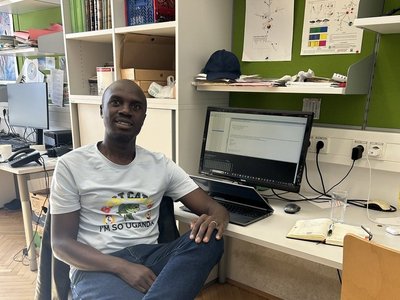
On 20 January 2026, Gerald Kwikiriza successfully defended his PhD work and passed with a distinction and was subsequently awarded a PhD. His work examined how human-assisted movement of live fish between locations, followed by their release into new environments, influences the genetic structure and hybridization levels (mating between different species) of native tilapia species. This was further complemented by an assessment of how fish farming practices contribute to similar genetic changes in natural populations.
His PhD was motivated by the fact that Uganda’s freshwater ecosystems, particularly Lakes Victoria and Kyoga, are increasingly threatened by overfishing and the introduction of invasive fish species. These pressures have significantly contributed to the severe decline of native Oreochromis species, especially Singida tilapia (O. esculentus), which is now primarily confined to satellite lakes in Uganda. In contrast, non-native species such as Nile tilapia (O. niloticus) and blue-spotted tilapia (O. leucostictus) have become dominant. Nile tilapia, in particular, is the leading aquaculture species due to its high productivity and market value. While aquaculture offers clear benefits by boosting fish production and income, it also presents ecological and genetic risks. In Uganda, there are relatively few studies focused on the genetic monitoring and conservation of Oreochromis species. Therefore, understanding the current distribution and genetic status of both native and introduced Oreochromis species is essential for designing effective conservation and aquaculture management strategies. In this study, samples were collected from aquaculture facilities—including cages, ponds, and hatcheries—as well as from landing sites and satellite lakes associated with Lake Victoria and Lake Kyoga. Fish from farms showed varied admixture patterns, with pond populations having higher genetic mixing than cage and hatchery samples, reflecting seed sourcing practices. Four genetic groups were detected, with cage and hatchery stocks clustering closely, while ponds contained fish from both wild and hatchery sources. These findings highlight the need for coordinated genetic management in Uganda’s aquaculture. Wild Oreochromis species exhibited low genetic diversity, yet showed clear species differentiation and limited hybridization among Oreochromis species. However, O. esculentus showed genetic erosion, emphasizing the importance of protecting satellite lakes that still harbor pure stocks. This study supports a productive and ecologically responsible aquaculture sector in Uganda. This PhD work produced five manuscripts; these manuscripts and many more can be found on his google scholar profile: Google Scholar.
Before the completion of the PhD, Gerald was employed as an Aquaculture scientist with the National Agricultural Research Organisation (NARO) Uganda and at the same time as a research assistant at Makerere University. Gerald is especially interested in linking evolutionary processes with practical solutions for sustainable fisheries and aquaculture. He has participated in numerous regional and international conferences and research collaborations. His ongoing efforts aim to promote sustainable aquaculture practices and improve fisheries resources.
Gerald acknowledges the Austrian Partnership Programme in Higher Education and Research for Development (APPEAR) for funding his study and his scientific supervisors for all their support: Prof. Harald Meimberg, Dr. Manuel A. C. Curto, Dr. Papius D. Tibihika, Dr. Andreas Melcher, and Dr. Juliet K. Nattabi. He is grateful to his family and friends for walking this journey with him.