Uganda is endowed with abundant freshwater ecosystems—lakes, rivers, and wetlands—that are vital for biodiversity, livelihoods, and national development. Yet these ecosystems are increasingly threatened by pollution, climate change, overexploitation, and habitat degradation. Ensuring their sustainable management is therefore a national and global priority. One effective strategy is to build capacity, strengthen international collaboration, and foster networking between higher education and research institutions, as demonstrated by the FRESH NET project.
From 6–9 May 2025, a FRESH NET workshop was held at BOKU University in Vienna, Austria. The event brought together about 40 representatives from more than 15 institutions in Uganda, Ethiopia, Kenya, and Austria—including universities, ministries, and organisations—to explore collaboration opportunities between FreshNet network partners and Ugandan universities and research organisations. Participants established new partnerships, exchanged experiences, and agreed on next steps for safeguarding freshwater resources.
APPEAR scholars and alumni played a central role in both the project and the workshop’s success. Florence Nansumbi, Amon Aine, and Gerald Kwikiriza—currently pursuing PhDs at BOKU—each have prior experience as research assistants at Makerere University (Florence and Gerald) and Kyambogo University (Amon). Adamneh Dagne, who earned his PhD at BOKU, is now a senior researcher in fisheries and aquaculture at Ethiopia’s National Fisheries and Aquatic Life Research Centre (EIAR-NFALRC), where he also coordinates the National Fisheries Research Programme.
During the workshop, these scholars and alumni facilitated sessions, contributed to panel discussions, and engaged in breakout groups designed to develop joint, multilateral, and bilateral collaboration initiatives. The sessions focused on defining priority areas for partnership and forming working groups to turn ideas into concrete action plans. Overall, the workshop created valuable opportunities to strengthen academic and research networks while advancing freshwater management and conservation efforts in Uganda and the wider region.
Amon Aine represented the Department of Biological Sciences at Kyambogo University, highlighting the university’s strategic role in cultivating leadership in aquatic ecology through collaborative research and innovation. He also introduced the planned master’s program, MSc in Aquatic Ecology and Environment Management, which is designed to build expertise and leadership in aquatic ecology within Uganda and across East Africa. In the breakout sessions, Amon contributed to the working group tasked with developing a roadmap for a jointly implemented master’s program, engaging all
participating research and academic institutions.
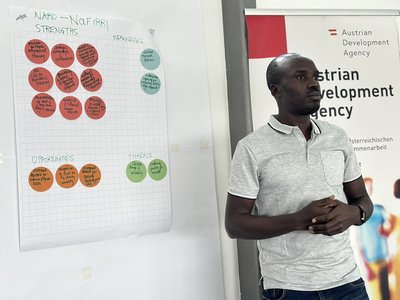
Gerald Kwikiriza served as one of the resource persons at the FRESH NET workshop, where he engaged in group discussions and delivered a SWOT analysis of Uganda’s National Fisheries Resources Research Institute on behalf of the Director of Research. His presentation highlighted the institute’s strategic priorities and how they can be aligned with collaborative initiatives among academic institutions in Uganda.
Adamneh Dagne gave a virtual presentation on Ethiopia’s research system, which is driven primarily by national and regional research institutions alongside universities. He introduced the Ethiopian Institute of Agricultural Research (EIAR)—a federal body overseeing 23 research centers across diverse agro-ecological zones and commodity areas. His presentation focused in particular on the National Fisheries and Aquatic Life Research Center (NFALRC), outlining its work in fisheries, aquaculture, and aquatic ecology, its infrastructure and human resources, and its extensive partnerships at national, regional, and international levels.