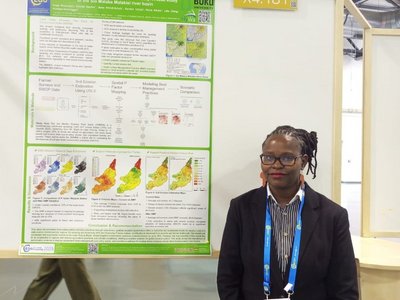
In her poster presentation entitled Integrating Farmers’ Perspectives and Scientific Knowledge to Manage Transboundary River Basins Sustainably: A case study of the Sio Malaba Malakisi River Basin, Hope explored how scientific data, and local knowledge can be combined to improve the management of rivers and catchments shared across national borders. Focusing on the Sio Malaba Malakisi River Basin, which spans Kenya and Uganda, she examined farmers’ perceptions of soil erosion, and the conservation measures they implement on their farms, comparing these to outcomes from scientific models. While most farmers reported soil degradation and declining fertility, spatial analysis revealed that at least 76% of the basin still lacked effective soil and water conservation practices, making it highly vulnerable to erosion. This discrepancy highlights the need to align community knowledge with scientific evidence. The study demonstrated that incorporating farmers’ insights could help shape Best Management Practices (BMPs) capable of reducing soil erosion in the catchment by up to 25%. Her findings also showed that integrating farmer perspectives with scientific tools supports more sustainable and inclusive management of shared water resources and serves as a valuable form of ground truthing, ensuring that interventions are relevant and practical, rather than abstract or misaligned with local realities.
The EGU conference provided Hope with valuable insights into environmental sustainability, the role of science in governance and much more. Key takeaways included the importance of interdisciplinary collaboration in addressing complex environmental challenges. Looking ahead, she is committed to engaging in research that involves local communities to strengthen conservation outcomes and improve local livelihoods. One of her key questions as a scientist and entrepreneur remains: What more can scientists do to bridge the gap between research and policy to ensure that successful practices are not only scaled but also translated into entrepreneurial opportunities for local communities, including farmers? The EGU also offered Hope opportunities for meaningful exchange with global experts, allowing her to grow her professional network and explore future collaborations in the field of geoscience and sustainability. Hope welcomes opportunities for collaborative research, particularly on water quality and soil conservation efforts in Kenya and similar contexts.
Hope Mwanake is a doctoral candidate at the University of Natural Resources and Life Sciences, Vienna (BOKU), in the Institute of Hydrology and Water Management, Department of Landscape, Water and Infrastructure. Her PhD research is supervised by Prof. Karsten Schulz and Dr. Matthew Hernegger (BOKU) and Prof. Luke Olang (Technical University Kenya). She was nominated for a scholarship within the APPEAR-funded project Capacity Building on the Water-Energy-Food Security Nexus through Research and Training in Kenya and Uganda | CapNex.
Her PhD research focuses on investigating how agricultural land use and soil and water conservation practices influence soil erosion, sediment yield, and water quality in the transboundary Sio Malaba Malakisi River Basin (SMMRB), shared by Kenya and Uganda. By combining water quality data, laboratory analysis, scientific modeling (USLE), spatial analysis, and local farmer perspectives, the study identifies key erosion hotspots, evaluates the effectiveness of current conservation measures, and proposes locally relevant Best Management Practices (BMPs) to reduce soil loss. The insights gained from this work are expected to offer useful guidance for similar data-scarce regions in Sub-Saharan Africa, illustrating how the integration of scientific analysis and community knowledge can support efforts toward the sustainable management of shared natural resources.
In addition to her academic work, Hope is a passionate environmental entrepreneur. She regularly conducts short courses and training programs in entrepreneurship, environmental science, and sustainability, with a strong focus on capacity-building for youth and communities. Hope is particularly interested in how scientific knowledge can be translated into tangible, market-ready solutions that empower local entrepreneurs, foster green innovation, and improve community livelihoods. She continuously strives to be at the forefront of preventing environmental pollution and enhancing conservation and healthy communities in Kenya.
Mwanake, H.; Mehdi-Schulz, B.; Schulz, K.; Kitaka, N.; Olang, L.O.; Lederer, J.; Herrnegger, M. Agricultural Practices and Soil and Water Conservation in the Transboundary Region of Kenya and Uganda: Farmers’ Perspectives of Current Soil Erosion. Agriculture 2023, 13, 1434. https://doi.org/10.3390/agriculture13071434