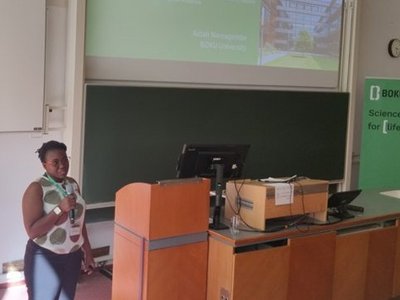
The 11th International Conference on Materials Science and Smart Materials (MSSM2025) was held from September 2–5, 2025, at the University of Natural Resources and Life Sciences (BOKU) in Vienna, Austria. The conference provided a platform for internationally recognized experts and emerging scientists to present and discuss scholarly work on recent advancements in materials characterization, manufacturing, and applications.
At the conference, Aidah Namagambe presented her research on the evaluation of renewable energy resources to establish a green and sustainable energy framework within the Bidibidi Refugee Settlement in Uganda. Her study focuses on supporting the development of a resilient, integrated energy system aimed at mitigating energy poverty in displacement settings. Recognizing that renewable energy resources such as solar, wind, and biomass are highly site-specific, the research emphasizes the importance of accurate estimation to determine the most viable resources for sustainable hybrid systems. The study introduces a comprehensive and adaptable methodology for renewable resource assessment that can be replicated in other regions, serving as a foundational step toward the design of hybrid renewable energy systems for remote and underserved communities.
Participation in MSSM2025 provided international visibility for Aidah’s research and recognition within the global scientific community. Constructive feedback from experts and peers offered valuable insights to further refine and strengthen the study, while opening opportunities for collaboration and future publication. The conference also contributed significantly to her professional development, fostering engagement with researchers and professionals worldwide and enhancing her understanding of the latest advancements and emerging trends in the field of materials and sustainable energy.
Abstract
Access to reliable, affordable, and sustainable energy remains a pressing challenge across remote and underserved regions of Uganda. In such settings, renewable energy technologies provide a viable and cost-effective alternative to conventional grid extension, which is often impractical and financially burdensome. This study evaluates the renewable energy potential of the Bidibidi refugee settlement in northern Uganda using statistical and geospatial data. Locally sourced agricultural residues were subjected to laboratory characterization to determine their physicochemical suitability for energy generation. Findings indicate abundant biomass resources, including crop residues, municipal solid waste, livestock manure, and sewage sludge, alongside significant solar irradiation and limited wind potential. The assessment shows that biomass is the dominant resource energy potential, complemented by solar energy. These results highlight the critical role of biomass and solar resources in advancing sustainable energy access through integrated systems, fostering environmental resilience, and enhancing long-term energy security for the Bidibidi refugee settlement.
Aidah Namagambe is a doctoral candidate at the Institute of Chemical and Energy Engineering (IVET) at the University of Natural Resources and Life Sciences (BOKU), Vienna, under the supervision of Univ.Prof. Dipl.Ing. Dr.techn Christoph Pfeifer, and Senior scientist. Assoc. Prof. Du. Rafat Al Afif. She serves as a part-time Assistant Lecturer at the Department of Chemical Engineering at Kyambogo University and Ndejje University, Uganda. She commenced her studies at BOKU University in December 2024 after receiving a scholarship award through the Austrian Partnership Programme in Higher Education and Research for Development (APPEAR), financed by the Austrian Development Corporation (ADC). She possesses a Master of Science degree in Renewable Energy from Makerere University and a Bachelor’s degree in Chemical Engineering from Ndejje University, Uganda. Her doctoral research concentrates on exploring the potential of hybrid renewable energy systems to achieve sustainable and resilient electrification in displacement settings, specifically examining the case of Bidibidi Refugee Settlement in Uganda. This research is conducted within the APPEAR Project Promotion of Hybrid Renewable Energy Systems Towards Electricity Access in Uganda (PHRE). The overarching goal is to enhance energy accessibility across Uganda by fostering the development and deployment of hybrid renewable energy solutions.