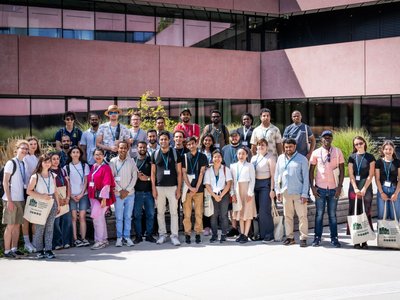
On 27 August 2025, around 45 OeAD scholarship holders joined our annual excursion to the Institute of Science and Technology Austria (ISTA) and Klosterneuburg Abbey, combining science, culture, and community. This short video offers an impression of our visit.
The first part of the day led the group to the Institute of Science and Technology Austria (ISTA) in Klosterneuburg, a world-class research institute founded in 2009. With its interdisciplinary approach and strong international focus, ISTA has become a hub for groundbreaking discoveries in physics, mathematics, computer science, and the life sciences. After an introduction to ISTA’s research areas, study programmes, and career opportunities, four scholarship holders under the ISTA summer fellowship made short presentations and shared their experiences during their scholarship stay at ISTA.
Sofia Vasieva – Caiazzo Group – Counting the undetectable: Completeness of the ZTF Magnetic White Dwarf (MWD) Search – Sofia talked about her work trying to detect the undetectable using synthetic signals made to simulate hypothetical rotating MWDs. Sofia also discussed her time as a summer fellow at ISTA and how it challenged her to step outside of her physics comfort-zone and pushed her towards data analysis and data science in ways she never imagined.
Shrriya Kapoor – Matthee Group – Little Red Dots: Probing the Birth of Supermassive Black Holes - Shrriya discussed her research into Little Red Dots, a recent astrological discovery that still puzzles many and it is not fully understood what these mysterious red compact sources mean for our understanding of the universe and supermassive black holes. As the first place winner at our poster session, Shrriya also discuss the impact this summer has had on her and the great friends she has meet and connections she has made.
Ethan Janes – Feng Group – How Does Heat Stress Affect the Tapetum to Compromise Pollen Development? – Ethan shared many of his microscope images he created while researching the affect of heat stress on plants. It is well known that heat exposure will compromise pollen development but his goal was the delve into the mechanism. Ethan also shared that his summer in ISTA was a growing experience full of many lessons including not to mark his microscope slides in pen (an elementary microscopy mistake) as well as being given full access to microscopes that let him develop his technical skills as a researcher.
Neeharika Sai Mahesh – Shigemoto Group – Physiological significance of the specific increase of left CA3 to right CA1 synapses on environmental enrichment – Her study utilizes both wild-type and conditional CA3-specific PirB knockout mouse models, which differ in hippocampal asymmetry, to explore difference in left CA3–right CA1 projections, which are characteristic of an enriched environment, that affect performance in memory tasks. The research design involves four phases: (1) six weeks of environmental enrichment, and a few mice in standard housing, (2) object location testing to assess spatial recognition, (3) Barnes maze testing for spatial navigation and learning, and (4) cued fear conditioning to probe hippocampal-dependent emotional memory. The project aims to determine whether experience-dependent input-side asymmetry enhances right CA1-dependent memory and whether environmental enrichment can mitigate behavioral deficits in mice with asymmetry deficits.
As one participant expressed in the feedback: “It was inspiring to see how international collaboration and research come together at ISTA. I left motivated to think bigger about my own academic path.”
A guided tour of the campus highlighted how state-of-the-art infrastructure meets a unique location in the heart of the Vienna Woods. Scholarship holders had the chance to gain first-hand impressions of ISTA’s innovative spirit and the daily life of researchers on campus.
As one participant expressed in the feedback: “It was inspiring to see how international collaboration and research come together at ISTA. I left motivated to think bigger about my own academic path.”
In the afternoon, the scholarship holders explored the long history of Klosterneuburg Abbey. The guided tour showcased more than 900 years of history, from Gothic to Baroque architecture, and included a visit to the renowned Verdun Altar.
A scholarship holder highlighted this in the evaluation: “The abbey tour was breathtaking. I really enjoyed the mix of science in the morning and culture in the afternoon—it felt perfectly balanced.” The excursion not only enriched participants’ academic and cultural knowledge but also fostered connections among international scholarship holders. Many emphasised how valuable it was to meet peers from different countries and disciplines.
One participant wrote: “I truly appreciated the chance to connect with other scholars. It made me feel part of a bigger community.” Another added: “The excursion was a wonderful reminder of why cultural exchange matters. We learned, shared, and laughed together.”
Overall, the feedback was overwhelmingly positive. Several participants praised the combination of innovation and tradition as unique and memorable: “This was one of the highlights of my time in Austria. The excursion gave me both inspiration for my studies and unforgettable cultural impressions.” The excursion not only offered profound insights into both cutting-edge science and rich tradition but also created space for exchange, reflection, and networking among the participants.
This excursion was kindly supported by the Province of Lower Austria.