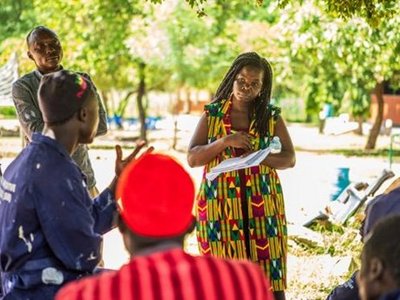
A key milestone was the successful implementation of the AMUTI Transdisciplinary Summer School 2025, which brought together 18 Master’s students from Muni University and BOKU. The programme was delivered in two phases: an online seminar introducing systems thinking, transdisciplinarity, gender, and intersectionality, followed by a field-based component in Arua and Rhino Camp Refugee Settlement. During the field phase, students engaged with communities, applying participatory research methods in areas including renewable energy, soil and water conservation, and natural resource governance. The summer school culminated in a community workshop where students presented their findings, reinforcing stakeholder engagement. In addition to contributing to academic credits, the summer school also served as a knowledge creation platform for AMUTI PhD research.
Additionally, the approval of the Muni University Community Engagement Policy by the University Council represents a key achievement for the project. The policy establishes a structured approach for engaging with communities and ensures that the university’s teaching, research, and outreach activities are closely aligned with local needs and priorities. This development strengthens the foundation for integrating experiential and community-based learning within academic programmes and reinforces Muni University’s role in fostering inclusive, locally grounded development processes.
At the doctoral research level, all AMUTI PhD candidates made significant progress in their research. This included the refinement of research methodologies and the advancement of community-based fieldwork using participatory and transdisciplinary approaches. Activities included conducting focus group discussions, community mapping exercises, and stakeholder workshops, particularly on issues related to natural resource governance, energy access and soil health management. Collaboration between BOKU MSc students and AMUTI PhD candidates further enriched the research process. Three MSc students conducted fieldwork over a six-week period, applying mixed methods such as participant observation, interviews, focus group discussions, and workshops, thereby contributing to both their own theses and the broader AMUTI research agenda. AMUTI PhD candidates also participated in international conferences and workshops, contributing to knowledge exchange on topics such as energy transitions, natural resource governance, and research in conflict-affected settings.
The project advanced experiential learning through the second edition of the Community Practice Internship Programme for Bachelor of Agriculture students at Muni University. This is an experiential learning programme that places students directly within rural and refugee-hosting communities, where they work collaboratively with local stakeholders to address real-world challenges in natural resource management. In parallel, the MSc curriculum in Environment and Natural Resources was approved by the Muni University Senate and is now progressing toward accreditation by the National Council for Higher Education, marking an important step in institutional capacity development.
Significant progress was also made in strengthening research infrastructure. Muni University acquired laboratory equipment, including a Kjeldahl Nitrogen Analyzer, UV/VIS spectrophotometer, shaking incubator, flame photometer, and laboratory fume hood, enhancing capacity for soil and water analysis and supporting both teaching and PhD-level research.
AMUTI project