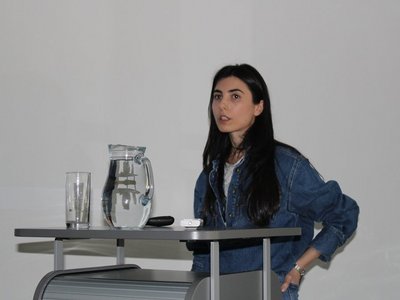
Seda Adamyan recently attended the Young ÖGHMP (Österreichische Gesellschaft für Hygiene, Mikrobiologie und Präventivmedizin) Symposium in Vienna, Austria on 24 October 2025. This important event, organized by the Austrian Society for Hygiene, Microbiology and Preventive Medicine, brought together young researchers and professionals to discuss the latest findings in microbiology, hygiene, and preventive medicine, with a particular focus on emerging infectious diseases and public health challenges. As a PhD student supported by the OeAD, presenting at the Young ÖGHMP Symposium was an invaluable opportunity to network with experts in my field, to gain insight into current research in Austria and Europe, and to showcase the relevance of my work to the Austrian scientific community.
Her presentation, titled "Dirofilaria and leishmania in Armenian mammals" examined the prevalence of Leishmania and Dirofilaria species across multiple host populations in Armenia. This study contributes to a better understanding of vector-borne zoonotic diseases in the South Caucasus region and highlights the importance of integrating parasitological, serological, and molecular approaches when assessing disease circulation in areas with overlapping wild and domestic host populations.
Objectives for Attending the Symposium
The main objectives for attending the Young ÖGHMP Symposium were to:
• Present my research on vector-borne parasites in Armenia to an Austrian and European audience of young scientists and established researchers in the fields of hygiene, microbiology, and preventive medicine.
• Network with leading experts and young researchers in Austria and explore opportunities for collaboration, particularly in expanding the scope of my research on zoonotic diseases and vector-borne infections.
• Gain insight into the latest diagnostic techniques, research methodologies, and public health strategies being developed in Austria and Europe that could be directly applied to my ongoing PhD research.
• Learn about current challenges and innovations in preventive medicine and hygiene practices relevant to my field of study, particularly regarding emerging infectious diseases.
Abstract
Vector-borne parasites are an emerging concern in Armenia, where wild carnivores and domestic dogs may act as reservoirs for zoonotic pathogens. As part of her PhD research, she conducted extensive fieldwork, collecting blood and tissue samples from several regions across the country. Dissections were performed on wild carnivores to recover adult parasites, and dog blood samples were examined using the Knott test.
In the laboratory, molecular protocols were optimised for parasite detection. Several PCR assays were evaluated for Leishmania; as all wild carnivore samples were negative, dog samples were used to validate the method, confirming one positive case. PCR detection for Dirofilaria was more straightforward, though discrepancies arose when adult worms were recovered during dissections but the corresponding PCR results were negative. This highlights a diagnostic limitation: circulating microfilariae are not always detectable in the blood, and a PCR-negative result does not necessarily exclude infection.
Preliminary results indicate Dirofilaria infections in 7 out of 32 wild carnivores (21.9%), 38 out of 69 dogs (55.1%) and 2 out of 3 captive bears (66.7%). One case of Leishmania was detected in dogs (1.4%). Positive cases were recorded in the Yerevan, Ararat and Shirak regions, with some areas showing overlap between wild and domestic hosts. These findings emphasise the importance of combining parasitological, serological and molecular approaches to assess parasite circulation. Ongoing screening and molecular characterisation will provide deeper insights into the epidemiology of vector-borne pathogens in Armenia.
Learning Outcomes
Attending the Young ÖGHMP Symposium was an invaluable experience that exposed Seda Adamyan to cutting-edge research in microbiology, hygiene, and preventive medicine within the Austrian and European context. The presentations and discussions provided advanced knowledge on disease detection methods, infection control strategies, and emerging public health challenges. The symposium format, specifically designed for young scientists, created an excellent environment for peer-to-peer learning and mentorship opportunities with established researchers in the field.
Through interactions with Austrian and international scientists, Seda Adamyan discussed her work on zoonotic diseases in Armenia, received valuable feedback for her research methodology, and explored potential collaborations. Several attendees expressed particular interest in the diagnostic challenges she encountered when comparing parasitological and molecular detection methods, as well as the ecological factors influencing disease transmission in the South Caucasus region. She was able to establish connections with researchers working on similar parasitological questions in other geographical contexts, which may lead to comparative studies in the future.
The symposium also exposed Seda to innovative approaches in molecular diagnostics and epidemiological surveillance that she can apply to my ongoing research. Discussions with experts in the field helped me refine my understanding of the limitations of PCR-based detection methods and reinforced the value of using multiple diagnostic approaches in parallel.
This opportunity was instrumental in allowing her to present herwork to the Austrian scientific community, connect with experts in hygiene and microbiology, and further my research ambitions. The skills, feedback, and connections Seda Adamyan gained from the symposium have directly impacted her research trajectory and enabled me to make a meaningful contribution to the understanding of vector-borne zoonotic diseases in Armenia and their potential public health implications.
Seda Adamyan is a PhD candidate at the Medical University of Vienna, specializing in the role of jackals in the diversity and distribution of zoonoses, especially Leishmania and Dirofilaria spp. in Armenia. Her research examines the ecological and environmental factors that contribute to the transmission of these vector-borne diseases. Seda holds a master's degree in biology from Yerevan State University and has participated in international research projects, including studies on parasitic infections in domestic animals. She has presented her findings at conferences such as EMOP, ÖGTPM and the Young ÖGHMP Symposium, highlighting the link between wildlife disease ecology and public health. Seda is passionate about exploring the dynamics of zoonotic diseases to improve health outcomes for both animals and humans.