The PhD research ‘Institutional Actor Interaction on the Governance of Natural Resources in a refugee-host community: A case of Rhino camp refugee settlement in Westnile sub-region, Northwestern Uganda‘ is conducted qualitatively using transdisciplinary, participatory, gender-transformative and intersectional research approaches to assess and analyse the interaction of the formal and informal institutional actors in the governance of natural resources in a refugee hosting community.
The study is part of the APPEAR project ‚Strengthening transformative capacity of Higher Education Institutions for equitable and resilient governance of natural resources in refugee-host community settings in West Nile subregion of Uganda – AMUTI‘.
In account of its progressive refugee policy ingrained in the 2006 Refugee act, Uganda is a host to over 1. 9 million refugees and asylum seekers mainly from South Sudan, Democratic Republic of Congo, Sudan, Burundi and many other African countries. The Rhino Camp refugee settlement is one of the oldest refugee settlements in the country. Opened in the 1980s in the aftermath of the South Sudanese civil war and influx to Uganda, the settlement is situated in the Northwestern part of Uganda and sits on approximately 233 sq Km of land. Currently it holds over 170,000 refugees, the highest percentage (60%) of which are from the Republic of South Sudan followed by Democratic Republic of Congo, Republic of Sudan and Rwanda. Within the Rhino camp settlement, the refugees and host community share resources including the natural resources (water, land, vegetation cover) and over time, this has intensified land degradation, woodland loss, competition for water and rangeland resources which often resulted into tensions and conflicts, particularly due to the over utilization. There is need for an efficient system to ensure the equitable and resilient governance of these natural resources.
Aware that the governance of natural resources is a collective action that requires the interaction of all institutional actors to aid in alleviating tensions and conflicts, co-creating strategies through the cooperation of formal and informal institutional actors from both the refugee and the host communities is crucial in ensuring an equitable and sustainable governance system while building a resilient refugee - host community. It is also paramount in mitigating the potential of recurring conflicts and tensions in an already conflict augmented community such as Rhino camp refugee settlement
This study examines the state of institutional actor interaction and highlights the areas of conflict and tensions within a refugee hosting community. Moreover, it sheds light on how these interactions shape the equitable governance of natural resources on which livelihood is highly dependent in such a set up. Therefore, this study will strengthen the governance of natural resources by co-creating strategies that ensure equitable and resilient systems. Ultimately, this study will offer practicable recommendations to support implementation of refugee assistance programs to ensure the respect and dignity of refugees while conserving natural resources.
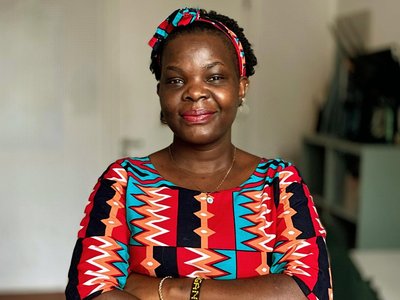
Jessiecah Alunyu Apili holds a bachelor’s degree in agriculture from Gulu University in Uganda. She graduated with a master’s degree in Agricultural Information and Communication Management from Haramaya University - Ethiopia under the sponsorship of the Regional University Forum for Capacity Building in Agriculture (RUFORUM) in 2016. Her master’s thesis focused on the effectiveness of mobile phone supported market information in promoting agricultural marketing in Northern Uganda. With a deep interest for Global development, she furthered her studies at the Open University - UK in Global Development under the Commonwealth scholarship. She is an alumna of the Young African Leaders initiative (YALI)-East and Central Africa where she acquired a certificate in Civic Leadership and Advocacy with funding from the U.S. government through the U.S. Department of State and USAID. For close to ten years Jessiecah worked with national and international development agencies in Uganda implementing agricultural, gender transformative, women and youth - led humanitarian and Market systems development projects. Additionally, she has worked as a part time lecturer at Gulu University training students on gender, rural development, media laws and Ethics and agricultural communications from 2016 to 2023. Shortly before enrolling for the PhD, Jessiecah worked as the Women Economic Empowerment and Market Systems advisor at Care International in Uganda implementing the Gender Equality and Resilience project (GEAR), an Austrian Development Cooperation project funded through CARE Austria to support refugees, women, youth and marginalised groups in Westnile sub-region and Gulu City in Uganda.