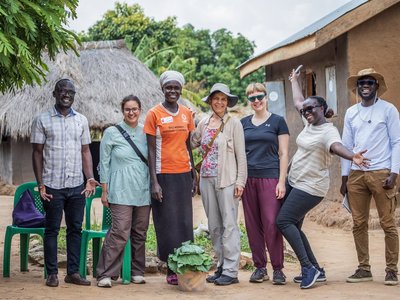
The title of her research is “Negotiating inclusion: an intersectional feminist approach to natural resource governance in refugee-host communities, Uganda.” Her research is financed within the APPEAR project Strengthening transformative capacity of Higher Education Institutions for equitable and resilient governance of natural resources in refugee-host community in West Nile, Uganda | AMUTI.
Conceptually, the AMUTI (Working Together) project is framed as an environment, in which higher education institutions and refugee-host communities jointly increase their capacities and explore new, more equitable and resilient ways of governance and management of natural resources. For this reason, a summer school programme is in cooperated to supplement data collection through fieldwork in the PhD study while reaching other project goals of increasing teaching capacity and skills, bolstering Muni University’s experience and repertoire, locally. This summer school and additional PhD field studies provide a comprehensive, case study analysis of how layers of exclusion in decision making on resource governance at the household level influences actions that contribute to exacerbating negative effects of climate change. This work contributes deeper insights in using gender transformative approaches to understanding the social and ecological realities in the West Nile region, which have not been extensively researched.
The Rhino Camp refugee settlement in Uganda's West Nile region hosts refugees predominantly from South Sudan and the Democratic Republic of Congo, leading to significant environmental degradation due to overuse of natural resources like land, water, and forests, at an annual biomass depletion rate of 8%. The Ugandan refugee policy is considered one of the most progressive in the world because refugees are settled within the host community and given a 30x30 meters parcel of land for settlement and kitchen gardening, among other benefits, as opposed to enclosed in a fenced and military gated camp. Refugees also receive support from the UNHCR and its implementing partners, supporting refugees to meet their basic needs and enjoy their human rights. In spite of these initiatives, over 60% of Uganda’s 1.9 million refugees live in abject poverty. This increases competition for resources and causes tensions between refugees and host communities. Women and youth, who depend heavily on natural resources, face exclusion from decision-making, endure long journeys to access firewood, farmland and sometimes water, they have heavier workloads, all of which expose and increase their vulnerability to violence. Inclusive decision-making and sustainable farming practices could mitigate these challenges.
This PhD research project examines how inclusion is negotiated in natural resource governance in refugee-host communities. Through an intersectional lens, it explores power dynamics and causes of structural inequalities in the access, use and conservation of land, water and forest resources at the household level. In investigating how decision-making processes perpetuate exclusion, it further examines social roles and norms ascribed to women and men, structures, and processes that determine the nature of socio-ecological interactions. Moreover, it explores opportunities for co-creating sustainable solutions to bridge inequality gaps and further identify leverage points for collective action. For instance, cultural norms in West Nile prevent women, including refugee women, from owning or making land transactions exacerbating barriers to resource access. The study specifically analyses how layers of exclusion in decision-making affect intra-household, community, and environmental interactions. And how household actors potentially collaborate to ensure resource access, use, and conservation. This will enhance sustainable resource use and conservation through inclusive knowledge transfer which benefits marginalized groups, supports development of an MSc curriculum for Muni University to improve agricultural and natural resource governance practices, and fosters transformative community engagement for socio-economic development in the refugee-host community.
Caroline Paparu graduated from Uganda Martyrs University (UMU), with a BA in Ethics and Development Studies. She further received an M.A. in Refugees and Migration Studies from UMU and a second M.A. in International Development Studies from Saint Mary’s University, Halifax, Canada in 2020. Her research has informed development of programmes for refugees and host communities affected by conflict in Africa's Great Lakes region through the See Far Programme, funded by Medica Mondiale. She has extensive experience collaborating with young African women, girls, local authorities, and community members to co-create strategies for safer, violence-free communities, promote peacebuilding, and build capacity in community based psychosocial support, climate-smart agriculture and agro-based entrepreneurship as Project Manager See Far Programme Uganda Chapter. Since September 2024, she has been putting her previous research and refugee experience to good use through her PhD scholarship at BOKU University.