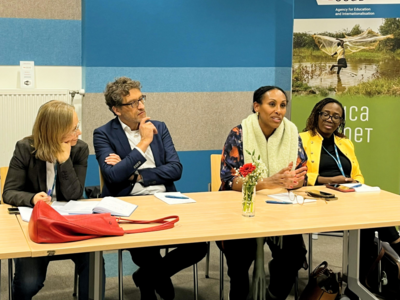
The Forum was hosted by the OeAD – Austria’s Agency for Education and Internationalisation – with support from the Association of Commonwealth Universities (ACU) and the Norwegian Directorate for Higher Education and Skills (HK-Dir). Throughout the event, participants shared the belief that international partnerships remain essential. They provide strong mutual benefits, not only for partner countries in the Global South but also for European institutions and societies. Such cooperation contributes to addressing global challenges, including poverty reduction, climate change, and progress towards the Sustainable Development Goals.
A key message of the Forum was that strong communication is needed to maintain support for these partnerships. Participants discussed how to present evidence in a clear and convincing way to decision makers, such as government representatives, institutional leaders, private sector actors, and the wider public. This evidence should highlight long-term socio-economic benefits, the positive impact of academic cooperation, and the global value created through shared knowledge and research. Good practices, case studies, evaluation reports, and impact assessments were seen as important building blocks for telling this story.
The programme began with a plenary session on “Higher Education Cooperation in a Changing World”, where speakers explored new global dynamics and emphasised the importance of collaboration to shape the future. A second plenary session, Anchoring Cooperation, looked at how higher education partnerships fit within broader policy frameworks and how these frameworks continue to evolve.
A key part of the Forum was the session “Making the Case”, which focused on using evidence to demonstrate the value of cooperation. Participants joined working groups to discuss the types of evidence they collect, their methods of data gathering, and the challenges they face when trying to measure impact. They considered questions such as which findings best show the usefulness of their programmes and how to overcome gaps in data or capacity.
These discussions continued in the workshop “From Data to Dialogue”, where participants reflected on how to communicate evidence effectively. They talked about communication channels, including policy briefs, social media, and public events, and shared examples of innovative ways to present data. Many participants also exchanged useful tools and resources that have helped them make their communication strategies more effective.
The Forum concluded with a session on new funding opportunities and ways for organisations to collaborate more closely, as well as two parallel sessions: one on support for scholars and institutions affected by conflict, and another showcasing good practice examples in stakeholder cooperation.
Overall, the Forum provided a valuable space for reflection, exchange, and joint problem-solving, helping organisations strengthen their strategies for communicating the importance of higher education cooperation worldwide.
The 16th S-DHG Forum 2026 will be hosted by the Finnish National Agency for Education (EDUFI).