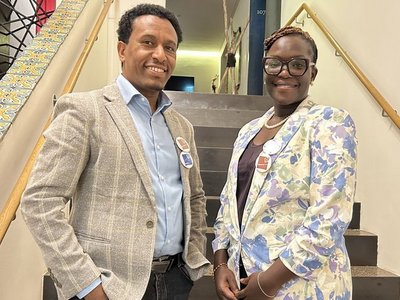
The Austrian Development Conference is gathering that brings together experts, civil society organizations, and policymakers to discuss global development challenges, social justice, and Austria’s role in international cooperation. The event promotes dialogue, networking, and the exchange of ideas for a more sustainable and equitable world. This year’s topic was “Peace, justice and strong institutions”. This year's conference took place from 21 to 23 November at the University of Innsbruck under the motto ‘Peace, Justice and Strong Institutions’.
On 22 November 2025, OeAD hosted the workshop ‘Project Work in Conflict-Affected Contexts’. The session brought together researchers, practitioners and students to explore how higher education cooperation can be sustained and strengthened in conflict-affected, politically unstable, or academically restrictive environments.
Rising global challenges: Setting the scene
In his opening remarks, Rainer Einzenberger (OeAD) highlighted the rapidly growing number of conflicts worldwide and their consequences for international cooperation. Geopolitical tensions, economic instability, the climate crisis, and the long-term effects of the pandemic have contributed to a landscape in which more wars are ongoing today than at any point in the last 80 years. Examples mentioned included the war in Ukraine, the Tigray conflict in Ethiopia, the civil wars in Myanmar, Yemen and Sudan, and the escalation of violence in Gaza. These developments directly affect OeAD programmes such as APPEAR and Cooperation Development Research (KoEF), which maintain partnerships and research collaborations in many fragile or politically sensitive regions.
Caroline Paparu (Uganda): Researching in a Shrinking Civic Space
In the first presentation, Caroline Paparu, a PhD student and APPEAR scholar at BOKU University drew on her research within the AMUTI project to describe the complex realities of working in Uganda’s West Nile region, an area characterised by large refugee populations, resource pressure, and increasing environmental degradation. She explained that development cooperation in Uganda takes place within a context of widening political tensions and a shrinking civic space, where funding freezes, misalignment of interests and certain government restrictions present tangible challenges for project implementation.
The AMUTI project, implemented in partnership between Muni University, BOKU University and the local NGO PALM Corps, focuses on equitable natural resource governance using transdisciplinary and participatory methods. Caroline described how the consortium integrates intersectional feminist approaches, co-learning formats and participatory action research to understand the dynamics between refugee and host communities. She emphasised that flexibility in such contexts hinges on genuine local ownership and continuous feedback from communities. Equitable partnership, she noted, requires an active effort to address language and knowledge barriers, ensure inclusive decision-making, and create accountability mechanisms that distribute power more fairly among partners.
Navigating ethical tensions—such as working with vulnerable groups, engaging local authorities, or avoiding the reproduction of inequalities—was a central theme of her presentation. She highlighted the importance of transparency, involving local leaders from the outset and embedding local governance structures into project processes so that no stakeholder is sidelined. To remain resilient, she argued, projects must invest in co-creation, gender-transformative approaches and community-based methodologies. She also reminded the audience of the emotional toll such work can take and stressed the importance of self-care for researchers operating in trauma-affected environments.
Hafte Mebrahten Tesfay (Ethiopia): Revitalising Academic Institutions After Conflict
In the second presentation, Dr. Hafte Tesfay a researcher from BOKU University and former APPEAR scholar, shared experiences from projects in Ethiopia, focusing on efforts to rebuild academic capacities in regions that have been heavily affected by the armed conflict. His KoEF-funded STRENGTH project at Bahir Dar University, Amhara region and the APPEAR-funded REVITAL-MU-ADU project at Mekelle and Adigrat Universities, Tigray region both aim to strengthen research, teaching and community engagement through agroforestry, capacity building and women’s empowerment.
Hafte illustrated how the conflict severely disrupted academic life: mobility restrictions prevented project teams from accessing field sites; communication networks were unreliable or collapsed entirely; and weak governance, overlapping authorities and security risks complicated even basic coordination. Procurement challenges, supply shortages and rising logistics costs added further obstacles. Despite these difficulties, project teams continued their work by adjusting research sites, reallocating budgets, mutual understanding with donors, shifting physical training spots to safer places, strengthening local leadership, offering remote supervision for PhD candidates and training local graduates to maintain continuity on the ground.
For Hafte, resilience lies in long-term commitment, mutual trust and sustained communication—even when partners cannot physically meet. He emphasised that project success in conflict-affected settings is often less about perfect implementation and more about shared dedication, flexibility and the willingness to adapt methodologies, timelines and expectations whenever conditions change.
Working Group Discussions: Collective Insights
Following the two inputs, participants formed four working groups to reflect on the workshop’s guiding questions.
• How can projects stay flexible and maintain impact when contexts shift unpredictably?
• What does an equitable partnership look like amid unequal conditions of access, mobility, or safety?
• How can we navigate ethical and practical tensions in politically sensitive environments?
• What measures and actions can strengthen resilience and adaptability?
The four working groups engaged in rich discussions that highlighted both the practical challenges and the opportunities for strengthening cooperation in conflict-affected contexts. Across the groups, several cross-cutting themes emerged.
A first set of discussions centred on flexibility and the ability to adapt quickly when circumstances change. Participants noted that data collection can become extremely difficult, especially when military actors are involved, and that research sites sometimes need to be shifted, for instance from rural to more stable urban areas. Yet even such adaptations are not always possible. Flexibility therefore also means adjusting schedules, reallocating activities, and being clear about who makes which decisions, particularly where power differences exist. Several groups emphasised that co-creation and transparent decision-making help maintain impact and ensure that benefits reach local communities.
A second theme was the centrality of communication and community engagement. Participants repeatedly stressed the need for continuous, multi-layered communication—not only within project teams but also with local authorities, community members and other stakeholders. Negotiations about access, security and responsibilities are often unavoidable. At the same time, projects must clearly communicate their political neutrality to avoid misunderstandings or instrumentalisation. Groups also highlighted the value of regular feedback mechanisms, such as suggestion boxes, community meetings or digital and hybrid communication formats, as well as citizen engagement approaches that help strengthen trust and ownership.
The groups also reflected on the challenge of navigating ethical and political tensions. Working in conflict-affected environments requires a deep understanding of cultural, local and political dynamics. This includes engaging with key stakeholders, addressing security concerns, and recognising the sometimes-significant differences between academic cooperation and humanitarian action. Participants noted that media perceptions, safety considerations and travel restrictions can all influence how projects operate. Ethical decisions, they concluded, need to be made with great care and in close dialogue with partners on the ground.
Another core theme was equitable partnerships. Participants highlighted that equal collaboration is built on trust, accountability and transparency, and that it cannot be achieved instantly but requires time to grow. Addressing power imbalances openly was seen as essential for creating a balanced relationship among stakeholders. Stability, diversity within teams and mutual respect were identified as key elements for sustaining long-term cooperation.
Finally, the working groups discussed how to strengthen resilience and adaptability. A bottom-up approach—grounded in local knowledge, community engagement and the involvement of relevant stakeholders—was considered vital. Participants emphasised that resilient projects are those capable of adjusting their activities and methodologies when needed, while maintaining strong networks that continue to function even in times of crisis.
Conclusion
The workshop illustrated how challenging—but also how valuable—international cooperation can be in conflict-affected countries. Despite insecurity, restricted mobility and political tensions, projects can succeed when they remain flexible, ethically grounded and built on trust. The experiences shared by Caroline Paparu and Hafte Tesfay demonstrated that meaningful collaboration is possible even in difficult environments, especially when local leadership is centred, power imbalances are actively addressed, and partners commit to long-term engagement.
We thank all speakers and participants for their valuable contributions and engaged discussions. The insights generated during this session will continue to inform APPEAR and KoEF as the programmes support cooperation in complex and rapidly changing environments.