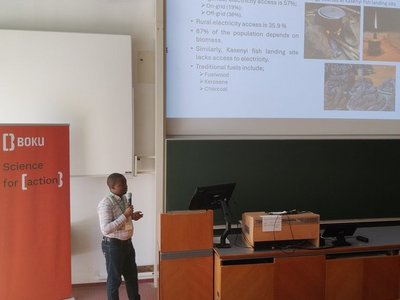
The Materials Science and Smart Materials Conference (MSSM2025) was held at BOKU University in Vienna, from 2–5 July 2025. It served as an international forum for researchers and practitioners to present and discuss the latest advances in materials characterization, design, development, manufacturing, and applications.
Sunday Asasio presented ‘Assessment of Renewable Energy Resource Potential for Hybrid Electrification: A Case Study of Kasenyi Fish Landing Site, Uganda’. His work concentrates on using geospatial analysis for comprehensive renewable energy resource assessment to guide sustainable energy planning and promote the deployment of decentralised power systems in underserved communities. The study establishes a foundation for future research focused on improving system design, maximizing resource utilization, and exploring the socio-economic impacts of decentralised energy deployment. The scholar gained expertise in renewable energy implementation and built a global network to promote innovation in energy and water sustainability.
Abstract of his paper: Uganda faces a persistent energy shortage, particularly in rural areas where electricity access remains limited. This study examines the biomass and solar energy potential at Kasenyi fish landing site in Kasese District, Uganda, to develop tailored sustainable energy solutions. Using ArcGIS Pro, solar radiation was quantified while biomass potential was estimated through statistical analysis. The results indicate that crop residues and solar energy are viable resources for meeting local electricity needs. Biomass availability was estimated at 22.60 kton/year, capable of generating 103,024 MWh/year through gasification. Solar potential reached 2,474 kWh/m²/year, translating to 102 MWh/year of usable energy. The combined potential yields an estimated 103,126 MWh/year. These findings support developing an integrated biomass and solar hybrid energy system. The study recommends leveraging geospatial analysis for energy planning and provides a foundation for future research to refine system design, optimise resource use, and examine the socio-economic impacts of decentralised energy deployment.
Sunday Asasio is a PhD student at BOKU University specializing in Renewable Energy Systems under the supervision of Prof. Christoph Pfeifer and Prof. Rafat Al Afif. He is a motivated energy specialist with a background in industrial chemistry and a strong passion for advancing the transition to clean energy and reducing carbon footprints. He has a proven track record in conducting renewable energy research, including resource assessment, technical design, market development, energy scenario modelling, and ISO management systems. Sunday is proficient in a range of analytical and modelling tools, including ArcGIS, HOMER, LEAP, RETScreen, MATLAB, SWAT, and OpenLCA, which he uses to support research, system optimisation, and sustainable energy planning. His PhD reseaarch is conducted within thje APPEAR Project Promotion of Hybrid Renewable Energy Systems Towards Electricity Access in Uganda (PHRE). The overarching goal is to enhance energy accessibility across Uganda by fostering the development and deployment of hybrid renewable energy solutions.