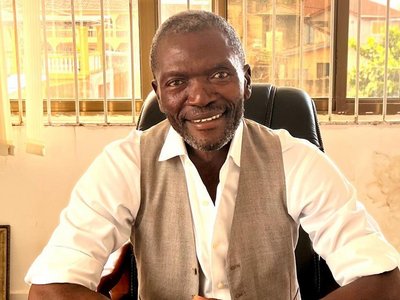
The Online Alumni Talk on 15 October 2025 featured Dr. Paul Yillia from Sierra Leone, who has over 25 years of expertise in applied science and engineering, focusing on technical assistance programs and analytical work in development, particularly in the water sector and more recently in decentralized renewable energy.
A warm welcome was extended to all participants at the Alumni Talk, by Elke Stinnig, APPEAR Programme Officer at OeAD, who served as the moderator for the session. She noted that she had known Dr. Yillia since his doctoral studies at the Vienna University of Technology. His PhD scholarship had been funded by the Austrian Development Cooperation and implemented by OeAD. Since completing his studies, Dr. Yillia had established a remarkable career in academia and worked with numerous international organisations.
Dr. Yillia’s presentation shared insights from his academic journey and professional career, reflecting on his time in Vienna and discussed The Energy Nexus Network and his mission to promote clean energy innovation and integrated development in Sierra Leone. The presentation was followed by a lively Q&A Session with the participants and a presentation of the OeAD Alumni Map.
Paul began his presentation by recalling that in 2015, he was invited to give an Alumni Talk, which at the time took place in person at the OeAD. He also mentioned his period working at the International Institute for Applied Systems Analysis (IIASA) in Laxenburg, near Vienna, when the OeAD organized an excursion for scholars to this prestigious institution. During that visit, he demonstrated his strong and ongoing engagement with the OeAD Alumni Network by sharing his experiences as a research scholar at IIASA and providing a brief overview of his professional career.
Academic and professional career
Dr. Yillia completed his PhD in 2008 at the Vienna University of Technology (TU Wien) under the supervision of Ass. Prof. Dr. Norbert Kreuzinger, supported by a scholarship from the Austrian Development Cooperation. His doctoral thesis, titled Linking Land Use to Stream Pollution: Pollutant Dynamics and Management Implications examined the relationship between land use patterns and their impact on stream pollution. After completing his PhD, he worked as a Postdoctoral Researcher and has since maintained a strong collaboration with TU Wien, resulting in several joint publications. Subsequently, he joined the International Institute for Applied Systems Analysis (IIASA), where he continued to advance research at the intersection of water, energy, and sustainable development.
Then he became a Programme Manager and Lead Policy Specialist on cross-cutting issues at Sustainable Energy for All (SEforALL). At SEforALL, he supported the overall SEforALL operational process to help countries align their energy policy/plans with SDG7 and SDG 13 targets and facilitated the action needed to ensure that SEforALL’s country action work supported national energy priorities and actions towards global energy and climate change targets. He led several actions to incorporate the water-energy-food nexus perspective within the overall SEforALL global action agenda and partner activities, in particular the linkages between energy and other key SDGs that are dependent on (and/or linked to) the energy goal.
Dr. Yillia maintains affiliation as a research scholar at the International Institute for Applied Systems Analysis (IIASA) and visiting teaching scholar and external examiner at the University of Malawi, Egerton University, Kenya, and Vienna University of Technology, where he previously held substantive positions in research and teaching and led transnational exchange of knowledge and skills on water science and technology, especially in developing countries and countries in transition. Prior to that, he undertook various assignments in the Netherlands with UNESCO-IHE Institute for Water Education and UNDP Cap-Net, University of Sierra Leone and Egerton University, Kenya holding various capacity building responsibilities within the framework of international development co-operation. In addition, he has led several consultancy assignments with various governments and international organizations, including FAO, UNECA, UNOPS, UNF, UN-Water, UN-Environment, UNESCO, UNIDO, UNICA, UNDESA, WHO and World Bank Group.
Paul has been featured in many high-profile interviews and awards, and he has authored several publications, including peer-reviewed articles, book chapters and policy briefs on a broad range of development issues. He has participated in the organisation and facilitation of several international events, with over 100 appearances and more than 80 presentations, including keynote speeches and moderation of high-level panels and discussions at several local and international events.
In May, 2018, at the 18th African Utility Week held at the Cape Town International Convention Centre, South Africa, he received the prestigious African Utility Week Industry Award in the category Outstanding Contribution Award: Water. Paul was one of five recipients honored since 2014 for exceptional leadership, vision, and dedication to the water industry. He was recognized for his analytical work in water resources assessment and planning, as well as his efforts to strengthen institutional collaboration across the water, energy, and development sectors.
The Energy Nexus Network
Currently, Paul is Founding Manager & Chief of Operations at The Energy Nexus Network (TENN), a regional energy ecosystem hub that he co-founded on his return home in Sierra Leone in 2021. Paul is leading efforts in the country on climate action and decentralized renewable energy (DRE) interventions at the nexus with social infrastructure. Most of the projects being developed and implemented are on alternative livelihoods, sustainable fisheries and agriculture values chains, electrification of healthcare facilities and resilient microbusinesses in remote rural areas to demonstrate solutions on DRE access for productive use and social infrastructure using the energy ecosystem approach to improve last mile energy services and solutions. The organization he leads (TENN) works as a facilitation mechanism to scale decentralized renewable energy and clean cooking solutions using sustainable energy (SDG7) as a critical catalyst to improve development outcomes. In addition, TENN provides advisory support services to strengthen the institutional capacities of key sector agencies, local institutions, and civil society to address energy and energy-enabling development priorities in a coherent way. According to Paul, the current global context has placed an increasing spotlight on climate action at the intersection with sustainable livelihoods and healthcare along with the critical need to build resilient safety nets for vulnerable populations. The interventions are initially focusing on building programmes in Energy-Healthcare Nexus and Energy-Livelihood Nexus for improved social outcomes in Sierra Leone. With his leadership, TENN has positioned itself strategically as an anchor organization to attract local and international partners design and implement initiatives/programmes that have maximum and sustained impact in the region. As lead and a local champion on the ecosystems approach, Paul is guiding a team of young early career enthusiasts to initiate and facilitate dialogue across sectors, as well as technical engagements across various scales to strengthen inter-sector linkages at the energy nexus with health, education, water, environment, climate action, agri-value chains to improve social outcomes and alleviate poverty. Working with local and international partners to develop and strengthen local ecosystems around modern and sustainable energy access and clean cooking solutions, the teams he is building are championing initiatives that foster strong ecosystems around decentralized energy access solutions on productive use applications for sustainable development. Paul says that larger goal is to establish a strong network of additional local champions and stakeholders such as green entrepreneurs, innovators, as well as sector champions for social infrastructure such as healthcare, agriculture, education, environment, and water supply and sanitation who would help to unlock energy access solutions for the poor in difficult to reach regions in the country.
Paul is also currently spearheading strategies for climate action and scaling decentralized renewable energy (DRE) interventions for social infrastructure in Sierra Leone. As Senior Technical Adviser to the Chairman of the Presidential Initiative on Climate Change Renewable Energy and Food security (PI-CREF), Paul is leading efforts to establish a Climate Finance and Energy Innovation Hub within the Office of the President of the republic of Sierra Leone to mobilize and manage resources for the country’s ambitious renewable energy transition and green growth plan.
Reflection
Reflecting on his training and experience in Austria - thanks to two scholarships from the Norh-South Dialogue Programme (now APPEAR) - and what he has achieved since his return to Sierra Leone, Paul says it is good and very satisfying to be back home after 20 years abroad. It feels like life is starting all over again after a fulfilling 20 years abroad undertaking applied research, systems analysis and engaging at the global level. It is A dream come true to be working now with young ambitious men and women in Sierra Leone to implement projects on strengthening healthcare facilities and projects on livelihood enhancement to provide alternative livelihoods and demonstrate productive use application of energy for small businesses in rural Sierra Leone. The projects are targeting last mile communities in remote rural areas in Sierra Leone where access to electricity is a major development challenge. High impact solutions on alternative livelihoods with high potential for scaling are being deployed as proof-of-concepts using solar PV technologies and process innovation to power primary healthcare facilities, agricultural value chains and different income generating activities targeting women and youth owned businesses in selected rural communities.
Discussion
The webinar with Dr. Yillia was marked by an engaging and inspiring discussion on interdisciplinary research, professional growth, and the integration of science with real-world application. Participants expressed deep admiration for his multi-disciplinary career trajectory, highlighting how his ability to bridge academia, policy, and implementation serves as a model for emerging scholars.
Several participants sought guidance on how PhD scholars can grow within the nexus of applied sciences. They inquired about potential institutions, networks, and forums that support interdisciplinary collaboration and capacity building in this field. Another key theme revolved around career pathways for young professionals aspiring to create global impact. Attendees asked whether early-career researchers should prioritize academic research, public engagement, or practical implementation to achieve meaningful transitions and influence.
Participants also reflected on the importance of evidence-informed decision-making in driving sustainable development. Dr. Yillia’s example reinforced the value of maintaining synergy between scholarly inquiry and applied solutions, inspiring attendees to persist in using science to inform policy and practice.
Conclusion
A warm thank-you to Dr. Paul T. Yillia for his truly inspiring talk. His journey—from his doctoral studies in Vienna to his leadership in Sierra Leone—has illustrated how academic knowledge, global experience, and personal commitment could create real impact on the ground. The audience deeply appreciated the insights he had shared about the challenges and opportunities in decentralising renewable energy, as well as the importance of innovation and partnerships. The Energy Nexus Network was highlighted as a remarkable example of how local action could drive global progress. Gratitude was also expressed to all participants for attending the session, for their thoughtful questions, and for contributing to an engaging and meaningful discussion.