The project “Advancing local capacities for livestock breeding practice and research in Burkina Faso” (LoCaBreed2.0) officially started in October 2022. Up to date, the activities implemented and the main achievements are:
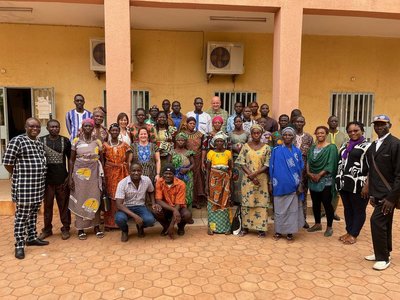
The project kick-off in Bobo-Dioulasso, Burkina Faso, was attended by members of the project team, farmers and representatives of decentralised livestock services (Photo N°1). This step, which was a milestone in the implementation of the project, enabled the various stakeholders to take a no-less-important assessment of the first phase of the project, Appear Project120 (LoCaBreed). It was another opportunity to build awareness, advocate and strengthen collaboration between project stakeholders. A great tool, the world café, was used to review and forecast the implementation of the current phase. About 50 attendees including 20 famers (mainly the beneficiaries of the phase 1), stakeholders, project team members took part to this meeting (Photo 2).
2 doctoral students recruited and enrolled at the Norbert Zongo University and the Nazi Boni University in Burkina Faso, 1 doctoral student enrolled at the Boku University in Vienna, 1 MSc student for training and strengthening local skills. In the same vein, former LoCaBreed doctoral students were designated as co-leaders of the LoCaBreed2.0 Work Packages.
After the kick-off meeting, the project team had a feel trip in September to meet stakeholders to officially lunch the field activities of LoCaBreed2.0. During this trip, meetings were held with regional authorities in charge of livestock and with livestock extension workers. Successively, the Regional Director of Agriculture, Animal and Fishery Resources of the South-West, the Provincial Director Agriculture, Animal and Fishery Resources and the Head of the office of Livestock and livestock extension workers of the communes of Bouroum-Bouroum and Loropéni (project sites) were met. All these stockholders were acknowledged for their collaboration in LoCaBreed and they were briefed on the achievements of this phase 1. The objectives and activities planned in LoCaBreed2.0 were presented. The project team emphasized that LoCaBreed2.0 will strengthen farmers breeding associations to sustain the community-based breeding programs. In this sense, contrary to LocaBreed in which extensions workers had a key role, in LoCaBreed2.0, more responsibility will be gave to farmers through the recruitment and the training of local enumerators who will record data and support farmers in collaboration with the project team.
- Farmers’ workshops for awareness raising
After the meetings with the stakeholders, the project team went in the field to held worksops with farmers. While the kick-off meeting was attended by farmers representatives, these worksops were hold with a large number of farmers including the beneficiariea of the phase 1 and news commers who want to join the CBBP in this new phase. Respectively at Loropéni and Bouroum-Bouroum, a feedback on the implementation and the achievements of LocaBreed following by the plan of LoCaBreed2.0 were presented to farmers by the project teamLoCaBreed2.0. Farmers expressed their satisfaction on the achievements of LoCaBreed and confirmed their commitment for the success of LoCaBreed2.0. Together with the project team together farmers discussed the difficulties encountered during the implementation of LoCaBreed and made suggestion for the successful implementation of LoCaBreed2.0.
Baseline survey is a key activity and the first step for the successful implementation of CBBP. The objective is to characterize and to have a better understanding of farmers production environment and systems, their breeding objectives in order to design and implementation CBBP local the needs of local communities. A total of 280 farmers including goat and cattle owners have been surveyed in the two areas.
- Animals identification, performances data recording and tissues sampling
Identification of all animals and recording of their phenotypes is another important activity in CBBP implementation. Up to date, about 1055 goats owners by 182 farmers were identified with ear tags in the two sites (708 goats and 126 farmers in Bouroum-Bouroum plus 347 goats and 56 owners in Loropeni) and their phenotypes recorded (Photo 3 ). For the purpose of genomic studies of the breeding population, tissues sample were taken for DNA extraction and genotyping.
- Setting up of online platform for data recording and management
Data recording and management is very important for the success of any breeding program and more for successful implementation of CBBP. Currently digitalization offers an opportunity of online data handling and management. In the context of LoCaBreed2.0, online pipeline with DTREO application was set up with the support of Abacusbio and members of the project team were trained in data recording and management.
In conclusion, based on the preliminary results of LoCaBreed2.0, despite the difficulties that all research and development projects face, the rewards look good for all farmers, researchers and other stakeholders.