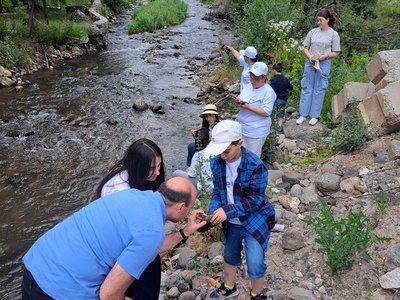
At the heart of this initiative is the collaboration with local schools in the project’s case study regions. The EcoServ team from the Scientific Center of Zoology and Hydroecology of the National Academy of Sciences RA (SCZHE) is working closely with schoolteachers and students, offering interactive training sessions and guidance on ecological monitoring techniques. Through hands-on learning experiences, students are applying bioindication methods to assess the ecological state of nearby rivers, deepening their understanding of local aquatic ecosystems while contributing meaningful data to the project.
In June 2024, EcoServ released Armenia’s first educational handbook dedicated to aquatic ecosystem monitoring: The Bioindication of the Ecological State of Rivers by Benthic Macroinvertebrates and Macrophytes (Gitutyun Publishing House, 108 pages, ISBN 978-5-8080-1542-5). Authored by EcoServ team members Marine Dallakyan, Hasmik Yepremyan, and Vardan Asatryan, the guidebook serves as a practical resource for field professionals, teachers, and students. It has already been distributed to key stakeholders in Armenia’s environmental sector, including staff at Sevan National Park and the Ministry of Environment, and was also handed out to participating teachers at the EcoServ Teacher Seminar.
This citizen science approach not only enhances environmental education but also empowers youth and women to participate in science and research. By integrating citizen science into the school curriculum, the EcoServ project supports project-based learning and encourages students to explore future careers in ecosystem management and sustainability. School visits to academic institutions, such as SCZHE, are planned to further inspire the next generation of researchers.
The EcoServ citizen science approach was also presented by team member Tigran Keryan in a talk titled “A Citizen Science Approach to Transform Aquatic Ecosystem Management in Armenia.” His presentation emphasized the importance of participatory ecosystem valuation and community-based monitoring, particularly in the face of challenges such as climate change and limited institutional capacity in Armenia.
These citizen science efforts reflect EcoServ’s commitment to bridging scientific research and community action. By actively involving local stakeholders, the project not only gathers valuable ecological data but also fosters a sense of stewardship and ownership among community members.
Funded by the Austrian Partnership Programme in Higher Education & Research for Development (APPEAR), the EcoServ project is jointly implemented by the University of Natural Resources and Life Sciences, Vienna (BOKU), Yerevan State University, and the Scientific Center of Zoology and Hydroecology of the National Academy of Sciences of Armenia.