The Joint MSc Programme in Aquatic Ecosystems and Environmental Management (AEEM) began as a joint master's programme of Addis Ababa University, Bahir Dar University and the Ethiopian Institute for Agricultural Research, with backstopping support from BOKU. It later expanded into its current international format in partnership with Egerton University. It is now welcoming its 13th cohort, reflecting steady growth and sustained relevance since its launch in 2013/2014.
Over the years, the Austrian Development Cooperation (ADC) has supported numerous students through master's scholarships. Many graduates subsequently pursued doctoral studies through North-South-Dialogue or APPEAR scholarship, both implemented by OeAD. Today, AEEM alumni contribute significantly to research, academia, government institutions, and environmental management across East Africa and beyond.
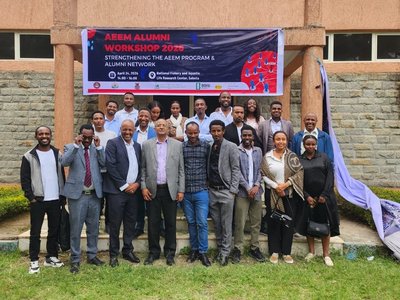
To discuss these achievements and explore future opportunities, the AEEM Alumni Workshop was organised as a side event of the EFASA Annual Conference. It took place at the National Fishery and Aquatic Life Research Center in Sebeta, Ethiopia, which is Ethiopia’s leading fisheries research institution. It drives sustainable fish production, aquaculture development, and conservation of aquatic biodiversity through research and technology transfer. The director of the center till April 2026 was Dr. Aschalew Lakew. Many former scholars have worked or are there still working as researchers: Dr. Kassahun Asaminew, Dr. Fasil Degefu and Dr. Redeat Habteselassie.
The workshop brought together AEEM alumni, faculty members, programme coordinators, and institutional stakeholders from partner universities and organisations. It discussed the continued relevance of the AEEM programme, gather alumni recommendations for programme improvement, strengthen alumni engagement, promote female participation, and identify opportunities for future collaboration and academic progression. It also provided a valuable platform to reflect on professional pathways, gender equity, and the long-term sustainability of the AEEM initiative.
The workshop was officially opened by H.E. Dr. Simone Knapp, Austrian Ambassador to Ethiopia, through a recorded message. In her remarks, she highlighted the programme as “one of the flagship examples of academic cooperation between BOKU University and universities in Ethiopia and Kenya,” describing AEEM as “a strong and inspiring example of what international collaboration in higher education can achieve.”
She further emphasized the importance of maintaining strong alumni connections: “A strong alumni network is one of the most valuable outcomes of any academic programme. It connects people across institutions, disciplines, and countries. It creates opportunities for collaboration, exchange, and mutual support, not only in research and academia, but also in professional life and beyond.”
Ambassador Knapp also underlined the global importance of water and environmental management, noting that climate change increasingly affects both Austria and East Africa. “This makes the work of AEEM not only relevant, but essential,” she stated.
Many former scholarship holders continue to play an active role within the AEEM community and in organising programme activities. One of the key workshop sessions on “Programme Improvement and Networking” was facilitated by Prof. Tadesse Fetahi, a former scholarship recipient who completed his PhD at the University of Vienna in 2010 and is now Full Professor of Limnology at Addis Ababa University and one of Ethiopia’s leading aquatic scientists.
The session encouraged participants to reflect on the academic relevance, practical effectiveness, and future direction of the AEEM programme. Discussions focused on curriculum relevance, academic structure, research training, thesis supervision, and the development of technical and professional skills. Participants highlighted the importance of establishing a more structured and active alumni network to facilitate knowledge exchange, collaboration, mentoring, and long-term programme visibility.
A strong consensus emerged regarding the value of the programme. Alumni consistently described AEEM as a high-quality and high-impact academic initiative that should be sustained, strengthened, and expanded to meet future environmental challenges in the region.
A second session, led by Dr. Abeba Amare, Gender Expert at Addis Ababa University, focused on increasing female participation in the AEEM programme and identifying practical measures to strengthen gender equity in access, academic performance, and leadership opportunities. Dr. Amare emphasised that female participation is not only a matter of equity but also a key driver of academic quality, innovation, and leadership development. Increasing women's participation, she noted, strengthens the talent pool, broadens perspectives, enhances problem-solving capacity, and contributes to long-term institutional impact.
In his closing remarks, Prof. Tadesse Fetahi welcomed the strong commitment expressed by alumni to strengthen the network through collaboration, mentorship, and professional engagement, ensuring the continued success of this long-standing partnership between East African and Austrian institutions. Through its graduates, research contributions, and with the support of the Austrian Development Cooperation, the AEEM programme continues to play an important role in addressing the complex water and environmental challenges facing the region and the world.