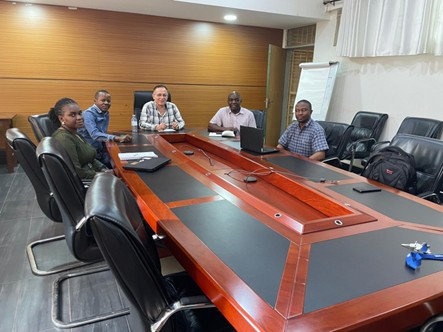
The training built directly on earlier cohorts, where participants had developed foundational skills in power electronics, sensing, microcontroller programming, PWM control, and battery charge controller design. In this round, these components were integrated into a fully functional hybrid renewable energy system.
Purpose and Focus
The training within the framework of ther APPEAR Project288: PHRE aimed to strengthen practical competencies in hybrid renewable energy systems by combining solar, wind, and battery storage technologies into one integrated model. Additional emphasis was placed on system thinking, hands-on engineering, and emerging fabrication methods such as 3D printing and CAD-based design. The course also functioned as a Training-of-Trainers (ToT) programme, strengthening local teaching capacity in renewable energy engineering.
Participants
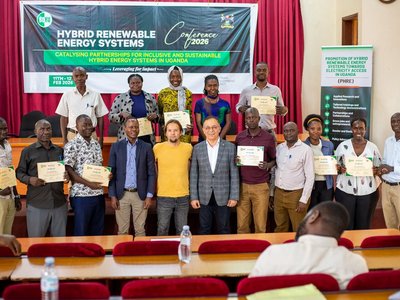
The cohort included both returning and new participants, primarily students and instructors from Makerere University. This continuity allowed deeper system-level learning, while new participants enriched peer learning dynamics. Gender inclusion improved compared to previous rounds, contributing to a more balanced technical learning environment and strengthening the long-term goal of inclusive capacity building.
Training Approach and Key Activities
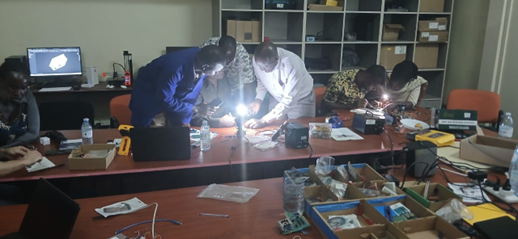
Over five days, the training combined theoretical review with intensive hands-on group work. Participants revisited earlier concepts such as sensor integration, battery charging logic, and power electronics before moving into system integration. Work was organised into specialised groups focusing on subsystems including solar tracking, water pump control, battery charging, and energy monitoring. These subsystems were then integrated into a unified hybrid model.
A key feature of the training was the transition from prototyping to system integration:
• A smart water level and pump control system was developed using microcontroller-based automation and electronic switching components.
• A custom hybrid charge controller was built to combine solar and wind energy inputs, regulate battery charging, and monitor voltage and current flows in real time.
• A safe charging algorithm ensured proper battery management using a standard constant-current/constant-voltage approach.
• Real-time monitoring was enabled through sensors and digital displays, allowing participants to observe system performance dynamically.
System Integration and Fabrication
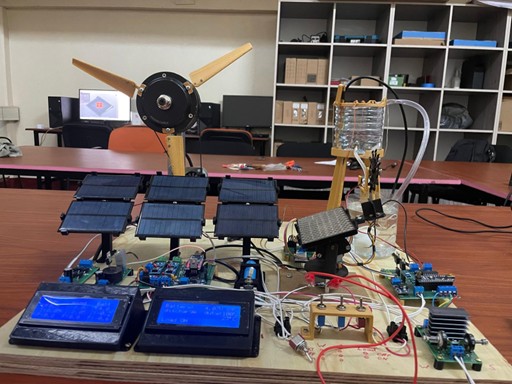
Participants assembled a complete hybrid energy model on a physical platform combining:
• Solar PV with tracking capability
• Wind turbine with rectification system
• Battery storage and charging system
• Water pump and hydro-related demonstration components
• Electrical loads simulating real energy use
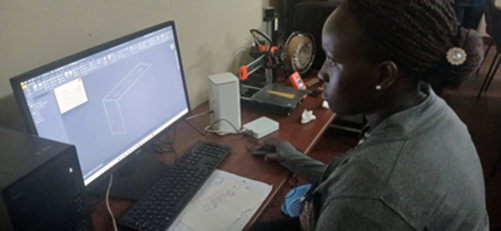
Mechanical components were designed using CAD software and produced via 3D printing, allowing participants to bridge digital design with physical system construction. Previously tested circuits were refined and permanently integrated into the final model.
Exposure Visit and Research Exchange
A field visit to operational mini-grids on Bunjako Island provided participants with real-world insight into hybrid energy deployment. A key takeaway was that technical design alone is insufficient for sustainability; long-term community engagement, sensitisation, and productive energy use are critical for financial and operational viability.
During Science Week, PhD researchers presented ongoing work on renewable resource assessment for hybrid electrification projects in Uganda, linking academic research directly to system design and deployment challenges.
Key Outcomes and Lessons
The training successfully demonstrated that iterative, hands-on learning significantly strengthens participants’ ability to move from individual components to fully integrated energy systems. It reinforced both technical competence and collaborative engineering skills.
Recommendations
To further strengthen impact, the following steps are recommended:
• Extend testing phases to allow long-term performance evaluation and fault analysis.
• Introduce structured data logging and system analytics for deeper performance insights.
• Strengthen collaboration with industry actors to align training outputs with real-world mini-grid applications.
• Sustain and expand the Training-of-Trainers model to build long-term institutional capacity.