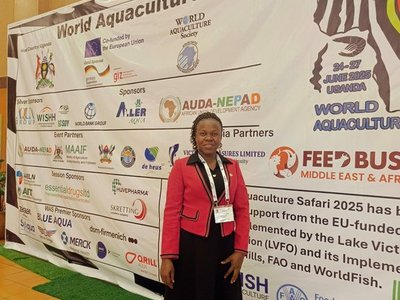
The World Aquaculture Safari 2025 (AFRAQ25), a major international aquaculture conference organised by the World Aquaculture Society, took place from 24–27 June at the Speke Resort Munyonyo in Kampala, Uganda — Africa's fourth-largest producer of aquaculture. With the theme “Aquaculture on the Rise”, the event aimed to showcase and accelerate aquaculture innovation in Africa and worldwide. The conference brought together aquaculture experts and stakeholders to share cutting-edge research and strategies for advancing the industry. She had the opportunity to present her research, titled 'Application of EPIC Markers to Cross-Amplify Tilapiine Species in East Africa'. This study focused on the use of novel, cost-effective genetic tools to assess biodiversity and support the conservation and management of wild and farmed tilapia species in the region. This contributes to the broader goal of building resilient fisheries and aquaculture systems. Presenters and participants provided invaluable feedback on the need to expand the application of EPIC markers to other cichlids. These markers reveal how genetic diversity in immune genes influences fish health, positioning them as valuable tools not only for population genetics, but also for applied aquaculture management. She received valuable guidance on the final objectives of her studies, which focus on assessing pathogen distribution and identifying novel genes associated with disease responses. Presenting at the conference enabled her to connect with aquaculture professionals, geneticists, conservationists, and aquatic health product developers working across Africa and beyond.
Tilapiines are a key source of food and income in East Africa, but their survival is under threat from disease and environmental changes caused by human activities and the effects of climate change. Catherine developed genetic markers known as EPIC (Exon Primed Intron Crossing), which are derived from the immune genes of Nile tilapia. These markers were used to analyse various tilapia species collected from Ethiopia, Kenya and Uganda, in order to evaluate their genetic diversity, differentiation and population structure. EPIC markers reveal how similar or different populations are and how much genetic mixing occurs between them. This information is important for breeding healthier fish and conserving wild populations.
Catherine Agoe is a doctoral candidate at the Department of Ecosystem Management, Climate and Biodiversity, Institute for Integrative Nature Conservation Research, Boku University, Vienna, and a part-time Assistant Lecturer in Aquatic Animal Health at Makerere University, Uganda. She joined BOKU University in September 2024, having received an individual scholarship award under the Austrian Partnership Programme in Higher Education and Research for Development (APPEAR), a programme of the Austrian Development Cooperation (ADC) implemented by Austria’s Agency for Education and Internationalisation (OeAD). She holds a Master of Science in Zoology from Makerere University, Uganda, which was supported by the Belgian Technical Cooperation (BTC). Her PhD study focuses on investigating disease resilience patterns and associated molecular markers in Nile tilapia (Oreochromis niloticus) in Uganda. The aim is to contribute to the development of resilient aquaculture systems through integrative research.